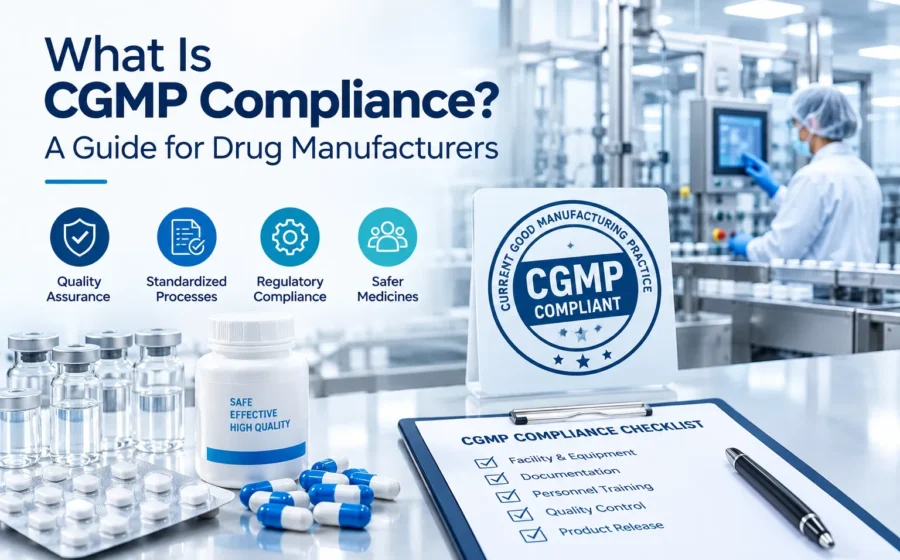
CGMP compliance means a drug manufacturer’s facilities, processes, and documentation consistently meet the FDA’s Current Good Manufacturing Practice regulations under 21 CFR Part 211. It’s the baseline every FDA-regulated manufacturer — sterile or non-sterile — must meet to legally produce and distribute drug products in the United States.
This guide explains what CGMP compliance actually covers, how it differs from plain “GMP,” what happens when a facility falls out of compliance, and how manufacturers verify and sustain it. You’ll also find direct answers to the questions QA/QC managers and pharma founders ask most about CGMP compliance.
What Is CGMP in Pharma?
CGMP compliance in pharmaceuticals means a manufacturer has documented, validated systems in place — covering facilities, equipment, personnel, production, and testing — that meet FDA requirements under 21 CFR Parts 210 and 211. CGMP stands for Current Good Manufacturing Practice, and the word “current” matters: the standard requires manufacturers to keep systems and technology up to date, not just compliant with practices that were acceptable years ago.
Definition box: CGMP compliance = a manufacturer’s demonstrated, documented ability to consistently produce drug products that meet identity, strength, quality, and purity requirements, under the specific regulations in 21 CFR Part 211.
According to 21 CFR Part 211, finished pharmaceutical manufacturers must maintain written procedures for production, quality control testing, equipment maintenance, and personnel training, with records that can be reconstructed for any given batch {external_source: 21 CFR Part 211 (FDA)}. CGMP is not a one-time certification — it’s an ongoing operating standard that FDA investigators verify during routine and pre-approval inspections.
Takeaway: CGMP compliance is the documented, current, and verifiable proof that a facility’s systems consistently produce safe, effective drug products — not a one-time checklist.
What Is CGMP Compliance in Pharmaceuticals?
CGMP compliance in pharmaceuticals is the ongoing state of meeting FDA’s Current Good Manufacturing Practice requirements across every stage of drug production — from raw material sourcing to batch release and post-market complaint handling. It applies to sterile and non-sterile dosage forms alike, though sterile products carry additional requirements for aseptic processing and environmental control.
CGMP compliance typically spans these core areas:
- Facility and equipment controls — cleanroom classifications, HVAC validation, equipment qualification (IQ/OQ/PQ).
- Personnel training — documented, role-specific CGMP training with periodic requalification.
- Production and process controls — validated manufacturing processes with defined in-process checks.
- Quality control laboratory operations — analytical method validation, stability testing, out-of-specification (OOS) investigation procedures.
- Documentation and records — batch production records, deviation reports, change control, and document retention.
- Complaint handling and post-market surveillance — systems for tracking and investigating product complaints and adverse events.
Takeaway: CGMP compliance covers the entire production lifecycle, not just the manufacturing floor — documentation and post-market systems are audited just as closely as the equipment.
What Are the 5 P’s of CGMP?
The 5 P’s of CGMP are a commonly used framework for remembering the core pillars of Current Good Manufacturing Practice: People, Products, Processes, Procedures, and Premises. Together, they represent the areas an FDA investigator evaluates during an inspection.
| P | What It Covers |
|---|---|
| People | Training, qualifications, hygiene, and documented competency of personnel involved in production |
| Products | Raw materials, in-process materials, and finished products meeting identity, strength, and purity specs |
| Processes | Validated manufacturing and testing processes that produce consistent, predictable results |
| Procedures | Written SOPs that are followed exactly as documented, with deviations recorded and investigated |
| Premises | Facility design, cleanliness, environmental controls, and equipment maintenance |
This framework is a teaching tool rather than an official FDA regulatory term, but it maps cleanly onto how inspectors structure their reviews. A weakness in any one “P” — for example, undertrained personnel or an unvalidated process — tends to surface as a Form 483 observation during inspection.
Takeaway: The 5 P’s — People, Products, Processes, Procedures, Premises — give manufacturers a simple mental checklist for where CGMP gaps most often appear.
Why Is CGMP Compliance Important?
CGMP compliance is important because it directly protects patient safety, and because non-compliance can result in FDA enforcement action that halts production, blocks product approval, or forces a recall. For manufacturers, it is also a commercial necessity — distributors, hospital systems, and international partners routinely require proof of CGMP status before signing supply agreements.
What’s at stake without it
- Patient safety risk — contaminated, mislabeled, or substandard product reaching patients.
- Regulatory action — Form 483 observations, warning letters, import alerts, or consent decrees.
- Business disruption — production holds, batch rejections, and delayed product launches.
- Reputational and financial damage — recalls are public record and can affect investor and partner confidence.
Sterile injectable manufacturers face particularly high stakes, since a CGMP failure in aseptic processing can directly translate to patient harm from contamination — which is why environmental monitoring and media fill programs receive close FDA scrutiny during inspections.
Takeaway: CGMP compliance isn’t a paperwork exercise — it’s the operational proof that a facility can be trusted to consistently produce safe drug product, and losing that proof has immediate business consequences.
How Is CGMP Compliance Verified?
CGMP compliance is verified primarily through FDA inspections — routine surveillance inspections, pre-approval inspections for new products, and for-cause inspections triggered by complaints or prior findings. Internally, manufacturers verify their own compliance through self-audits, mock inspections, and ongoing CAPA tracking.
How verification typically works
- Internal self-audit — QA teams review SOPs, batch records, and facility conditions against 21 CFR 211 on a scheduled basis.
- Mock inspection — a simulated FDA inspection, often run by an outside consultant, to test readiness and interview preparedness.
- FDA inspection — an investigator reviews records, walks the facility, and interviews staff, issuing a Form 483 if deviations are found.
- Establishment Inspection Report (EIR) — FDA’s internal classification of the inspection outcome as No Action Indicated (NAI), Voluntary Action Indicated (VAI), or Official Action Indicated (OAI).
Steripharm Solutions, led by Pramod Sharma, Ph.D., supports manufacturers through each of these verification stages — building internal audit programs, running mock inspections, and preparing CAPA documentation for sterile injectable, ophthalmic/otic, oral dosage, and transdermal product lines across the Americas, Europe, and India.
Takeaway: CGMP compliance verification happens on two tracks — FDA’s own inspection process, and a manufacturer’s internal self-audit and mock inspection program that should catch gaps before FDA does.
Frequently Asked Questions
CGMP stands for Current Good Manufacturing Practice, the FDA regulatory standard under 21 CFR Parts 210 and 211 for pharmaceutical manufacturing. The word “current” requires manufacturers to use up-to-date systems and technology, not outdated practices that were once acceptable.
Not exactly — GMP (Good Manufacturing Practice) is the general international quality concept, while CGMP is the FDA’s specific U.S. regulatory implementation of it. Other regions use their own GMP frameworks (such as EU GMP), which share core principles with CGMP but differ in specific requirements.
Non-compliance can lead to FDA Form 483 observations, warning letters, import alerts, or in serious cases a consent decree halting production. It can also block product approvals, trigger recalls, and damage relationships with distributors and partners who require CGMP status as a condition of doing business.
CGMP compliance is verified through FDA inspections — routine, pre-approval, and for-cause — as well as internal self-audits and mock inspections run by the manufacturer or an outside consultant. FDA classifies inspection outcomes as NAI, VAI, or OAI based on the severity of any findings.
CGMP in pharma is the FDA’s Current Good Manufacturing Practice standard requiring manufacturers to maintain documented, validated systems across facilities, personnel, and processes. It ensures every batch of drug product consistently meets identity, strength, quality, and purity requirements.
The 5 P’s of CGMP are People, Products, Processes, Procedures, and Premises — a teaching framework covering the core areas FDA investigators evaluate during an inspection. A gap in any one area, such as undertrained personnel or an unvalidated process, commonly leads to a Form 483 observation.
CGMP is important because it protects patient safety and because non-compliance can trigger FDA enforcement action that halts production or blocks approvals. It’s also a commercial requirement, since distributors and partners typically require proof of CGMP status before signing supply agreements.
Yes, CGMP under 21 CFR Part 211 applies to all finished pharmaceutical products, sterile and non-sterile alike, including oral solid dosage, transdermal, and topical products. Sterile products carry additional requirements for aseptic processing and environmental monitoring on top of the base CGMP framework.
FDA inspection frequency depends on facility risk classification, product type, and inspection history, but many manufacturers are inspected every one to three years, with sterile injectable facilities often inspected more frequently. A recent Form 483 or warning letter typically increases inspection frequency until issues are resolved.
Yes — many early-stage manufacturers build CGMP-compliant systems by combining a lean internal QA function with an outside compliance consultant for gap assessments, SOP development, and mock inspection prep. This approach lets a growing company meet CGMP requirements before it can justify a full in-house regulatory affairs department.
Conclusion
CGMP compliance is the ongoing, documented proof that a manufacturer can consistently produce safe, effective drug product — and it’s verified continuously, not certified once and forgotten. Whether you’re building a CGMP program from scratch or strengthening one after a Form 483, the goal is the same: systems that hold up under FDA scrutiny every time.
Steripharm Solutions LLC, led by Pramod Sharma, Ph.D., helps sterile injectable, ophthalmic/otic, oral dosage, and transdermal manufacturers across the Americas, Europe, and India build sustainable CGMP quality systems that stay inspection-ready.
Explore our capabilities → Steripharm Solutions Services