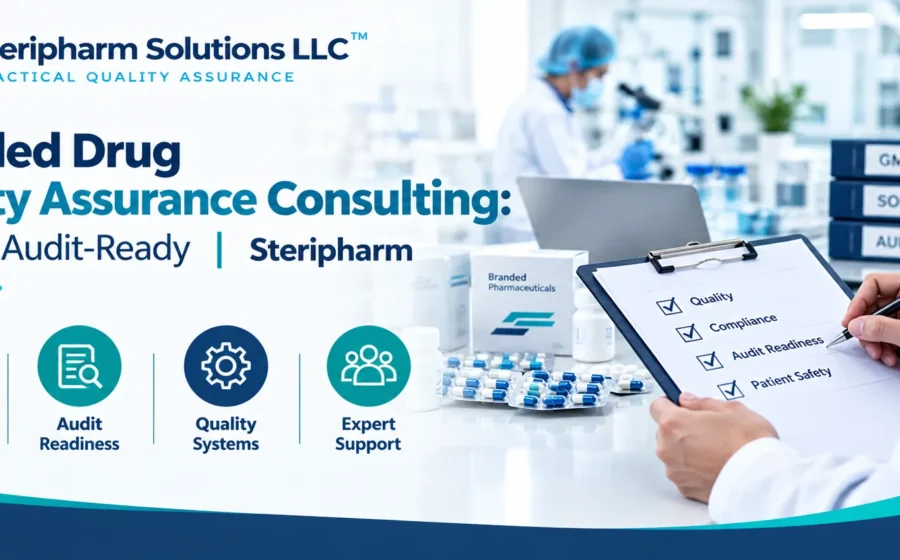
Branded drug manufacturers stay audit-ready at scale by running one consistent quality system across every site and contractor, tracking quality metrics continuously, and rehearsing inspections before FDA arrives. As commercial volume, product lines, and sites grow, informal practices that worked at small scale stop working, and branded drug quality assurance consulting helps close those gaps before an inspector finds them.
This guide covers the quality risks that come with scaling branded drug manufacturing, how multi-site oversight affects compliance, and how an outside QA partner supports inspection readiness. It is written for QA leaders and manufacturing executives at branded pharmaceutical companies.
[Internal Link: see our generic drug quality assurance guide (blog #26) → /generic-drug-quality-assurance-consulting/]
How Can Branded Drug Manufacturers Stay Audit-Ready as They Scale?
Branded drug manufacturers stay audit-ready as they scale by standardizing the quality system across all sites and contract partners, monitoring quality metrics and trends continuously, and running regular mock inspections. Audit readiness is a permanent operating state, not a project started when an inspection notice arrives.
Definition box: Branded drug quality assurance consulting = outside quality and CGMP expertise that helps a branded pharmaceutical manufacturer design, audit, and strengthen the quality systems supporting commercial manufacturing, so every site and partner stays inspection-ready.
Five habits of inspection-ready branded manufacturers
- One quality system, many sites. Procedures, deviation handling, and CAPA standards are harmonized, with local variation documented and justified.
- Continuous metrics. Deviation rates, CAPA aging, batch rejection, and complaint trends are reviewed routinely, not only before inspections.
- Risk-based audits. Internal and supplier audits focus on the highest-risk sites, processes, and partners.
- Rehearsed inspections. Mock inspections test documents, floor practice, and staff interviews.
- Leadership engagement. Management review drives resourcing decisions based on quality data.
Takeaway: Audit-ready at scale means the same quality standard applied consistently across every site and partner, verified by data and rehearsal.
What Quality Challenges Come With Scaling Branded Drug Manufacturing?
Scaling branded drug manufacturing brings challenges including inconsistent practices across sites, strained QA capacity, growing contractor dependence, higher complaint and deviation volumes, and slower investigations. Each challenge raises the chance of a Form 483 observation if quality systems do not scale alongside production.
| Scaling Challenge | How It Shows Up | Compliance Risk |
|---|---|---|
| Inconsistent site practices | Different SOP interpretations between sites | Repeat findings across inspections |
| Stretched QA capacity | Backlogged investigations and batch reviews | Late CAPA, delayed release |
| Contractor dependence | More CMOs and testing labs | Gaps in vendor oversight |
| Higher volume | More deviations and complaints | Missed trends |
| Rapid change | Frequent process and equipment changes | Weak change control |
Because a branded product carries the company’s name, a quality failure also carries reputation risk beyond the regulatory consequence: a recall or warning letter is public and affects customer and partner confidence.
Takeaway: Scaling multiplies every quality workload at once, so the quality system has to be designed to scale before volume grows.
How Does Multi-Site Oversight Affect Compliance?
Multi-site oversight affects compliance because FDA expects every site and contract partner to meet the same CGMP standard, and the manufacturer remains accountable for all of them. Weak consistency between sites, or weak oversight of contractors, creates findings that can affect the whole product line.
Effective multi-site oversight typically includes:
- A central quality unit with clear authority over site and CMO decisions.
- Harmonized procedures with documented, risk-justified local differences.
- Shared metrics so trends at one site are visible company-wide.
- Quality agreements that match actual practice with contractors.
- Risk-based audits of sites and CMOs, with CAPA tracked to closure.
[Internal Link: see our vendor audit framework → /pharmaceutical-vendor-audit-fda-cgmp/]
Takeaway: FDA holds the manufacturer accountable for every site and partner, so oversight must be consistent and centrally visible.
How Does Steripharm Support Branded Manufacturers?
Steripharm Solutions LLC supports branded manufacturers with quality strategy, optimization of existing quality systems, and management of CMO partnerships across the Americas, Europe, and India. The firm is led by Pramod Sharma, Ph.D., whose senior quality roles include Vice President, Quality at ImprimisRx (Harrow Health, Inc.), Senior Director, Quality at Alvogen and Albany Molecular Research, Inc. (AMRI), and Executive Director, Global Quality Compliance at Akorn, Inc.
That commercial manufacturing background covers sterile injectables; sterile ophthalmic and otic drops, gels, and ointments; non-sterile oral dosage forms; and sterile and non-sterile transdermal and transmucosal products, for both Rx and OTC drug manufacturers.
Takeaway: Steripharm brings senior commercial-manufacturing quality leadership to quality strategy, system optimization, and CMO oversight.
Frequently Asked Questions
They run a harmonized quality system across sites and contractors, monitor quality metrics continuously, audit on a risk basis, and conduct regular mock inspections. Inspection readiness is maintained as an ongoing state rather than prepared for at the last minute.
Main risks include inconsistent site practices, stretched QA capacity, heavier reliance on contractors, rising deviation and complaint volumes, and weaker change control during rapid growth. Each can lead to repeat inspection findings.
Challenges include harmonizing procedures across sites, keeping investigations and CAPA timely as volume grows, maintaining vendor oversight, and detecting trends across a larger data set. A scalable quality system addresses these before volume increases.
FDA expects every site and contractor to meet the same CGMP standard, and the manufacturer stays accountable for all of them. Inconsistent practices or weak oversight at one site can create findings that affect the whole product line.
Steripharm Solutions supports quality strategy, optimization of existing quality systems, and CMO partnership management across the Americas, Europe, and India, led by Pramod Sharma, Ph.D., whose prior roles include senior quality leadership at Alvogen, AMRI, Akorn, and ImprimisRx.
CGMP requirements are the same for both. Branded programs often add emphasis on brand reputation risk, lifecycle management, and complaint handling, while generics often face tighter cost and speed pressure. Both need an effective quality system.
A branded product carries the company’s name, so recalls, warning letters, and shortages are public and damage trust with patients, providers, and partners beyond the direct regulatory impact.
At least annually for major sites, and before any scheduled FDA inspection, new product launch, or significant change. Sites with recent findings may need more frequent rehearsal.
Useful leading indicators include deviation recurrence, CAPA aging and effectiveness, batch rejection rates, complaint trends, and overdue training or audit items. Rising trends often show problems before an inspector does.
Contact the team to discuss your quality, compliance, and manufacturing objectives. Steripharm then scopes an approach for your sites, dosage forms, and partners.
Conclusion
Scaling a branded drug business is a quality challenge as much as a commercial one. Manufacturers that standardize quality systems across sites, watch the data, and rehearse inspections stay audit-ready as volume grows.
Steripharm Solutions LLC helps manufacturers build sustainable compliance into every next step.
Contact our team → Contact Steripharm Solutions