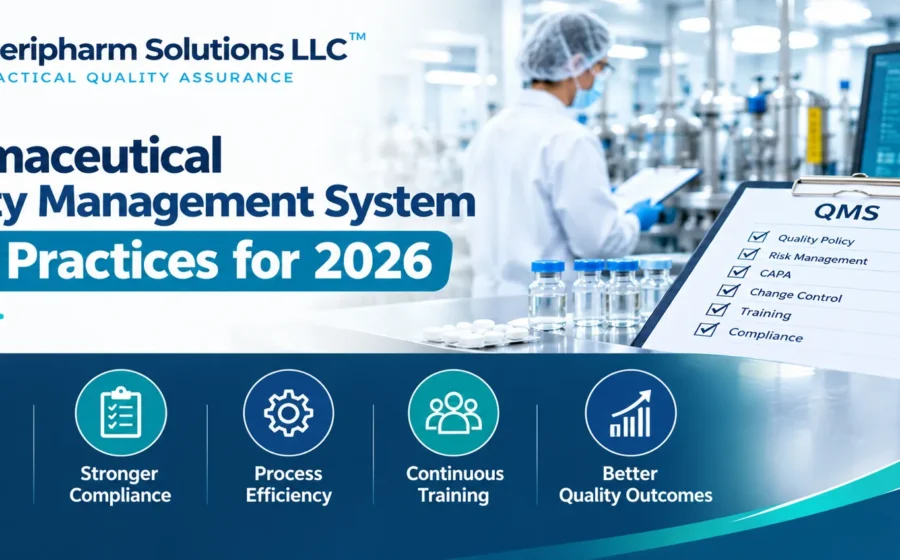
The best practices for a pharmaceutical quality management system in 2026 are: build a risk-based approach, protect data integrity, keep document control and change control tight, close CAPA with proven effectiveness, train for role-specific competency, audit on a risk-based schedule, give management review real decision power, and build a quality culture that leadership visibly owns. These practices turn a QMS from a binder of procedures into a system that prevents problems.
This guide lists ten pharmaceutical quality management system best practices that QA heads, quality managers, and manufacturing leaders can use as a checklist. It also answers common questions on review frequency, risk-based quality management, and how quality culture affects performance.
What Are the Best Practices for a Pharmaceutical Quality Management System in 2026?
A strong pharmaceutical quality management system in 2026 combines ten practices: risk-based decision-making, data integrity, document and change control discipline, effective CAPA, role-based training, risk-based audits, empowered management review, supplier oversight, quality metrics, and an owned quality culture. These practices align with ICH Q10, which describes a pharmaceutical quality system that supports consistent product quality and continual improvement across the product lifecycle.
Definition box: Pharmaceutical QMS best practices = proven, inspection-tested ways of designing and operating a CGMP quality management system so that it prevents quality failures, rather than only documenting them after the fact.
Takeaway: Best-practice QMS work in 2026 is about prevention and evidence: systems that catch problems early and prove, with data, that fixes worked.
10 Pharmaceutical QMS Best Practices Manufacturers Should Prioritize
1. Make quality decisions risk-based
A risk-based approach to quality management means matching the depth of investigation, audit frequency, and validation effort to the risk a process poses to patients and product quality. ICH Q9 (Quality Risk Management), updated in its R1 revision, provides the framework. Low-risk deviations get lighter handling; high-risk ones get full investigation.
2. Protect data integrity across every system
Data should be attributable, legible, contemporaneous, original, and accurate (ALCOA principles), with audit trails reviewed as part of routine batch and laboratory review. Gaps here, such as shared logins or unreviewed audit trails, are a recurring FDA concern.
3. Keep document control and change control tight
Every SOP and specification needs controlled versions, and every change to a process, equipment, or procedure needs formal assessment and approval before implementation. Document control is the foundation the other components depend on.
4. Investigate deviations to genuine root cause
Deviation investigations should go beyond “human error” to the process, system, or design cause. Shallow root causes are the main reason deviations recur.
5. Close CAPA only after effectiveness is proven
A CAPA is complete when monitoring data shows the problem has not returned over a defined period, not when the action is merely implemented. [Internal Link: see our CAPA process guide → /capa-process-pharmaceutical-industry/]
6. Train for role-specific competency, not attendance
Training records should show that each person is qualified on the current SOP version for their specific role, with periodic requalification. Inspectors often interview staff to confirm practice matches documentation.
7. Audit on a risk-based schedule
Internal audits should focus more often on higher-risk areas such as aseptic processing and data systems, with findings tracked to closure. Auditors should be independent of the area audited.
8. Give management review real decision power
Management review should examine trends in deviations, CAPA, complaints, and audit findings, then record decisions and resourcing. Metrics presented without action are a common gap.
9. Extend the QMS to suppliers and CMOs
The manufacturer remains accountable for contractor quality, so supplier qualification, quality agreements, and risk-based vendor audits belong inside the QMS. [Internal Link: see our vendor audit guide → /pharmaceutical-vendor-audit-fda-cgmp/]
10. Build a quality culture that leadership owns
Quality culture means staff report problems early, leaders respond constructively, and quality decisions are protected from schedule pressure. Culture shows up in behavior: how deviations are raised, how bad news travels, and whether QA authority is respected.
[Internal Link: see the 10 core QMS components inspectors expect → /cgmp-quality-management-system-components/]
Takeaway: The ten practices work as a connected set. Risk-based thinking decides where to focus, data integrity makes the evidence trustworthy, and culture determines whether the system is used in practice.
What Is a Risk-Based Approach to Quality Management?
A risk-based approach to quality management scales investigation depth, audit frequency, validation effort, and controls to the potential impact on patient safety and product quality. High-risk activities, such as sterile processing, receive the most rigor; low-risk activities receive proportionally lighter oversight.
This approach follows ICH Q9, which describes systematic assessment, control, communication, and review of quality risks. In practice, it means documenting why a decision was made at a given level of rigor, so the reasoning can be defended during an FDA inspection.
Takeaway: Risk-based quality management directs effort where patient risk is highest, and documents the reasoning.
How Does Quality Culture Affect QMS Performance?
Quality culture affects QMS performance because procedures only work when people follow them and raise problems honestly. In a weak culture, deviations are underreported, CAPA is rushed to meet deadlines, and records are completed after the fact. In a strong culture, issues surface early, when they are cheaper to fix.
Leadership behavior is the strongest signal. Visible support for QA authority, time allocated for investigations, and constructive responses to reported errors all raise QMS performance without adding a single new procedure.
Takeaway: A QMS is only as effective as the culture operating it. Leadership behavior sets how honestly the system is used.
How Often Should a QMS Be Reviewed or Audited?
A QMS should be audited at least annually, with higher-risk areas reviewed more often under a risk-based schedule, and formally reviewed by management on a defined periodic basis, commonly quarterly or semi-annually. Reviews should also be triggered by events such as an FDA inspection finding, a major deviation trend, or a significant process or facility change.
| Activity | Typical Cadence |
|---|---|
| Internal audits, high-risk areas | At least annually, often more |
| Internal audits, lower-risk areas | Every 1 to 3 years, risk-based |
| Management review | Quarterly or semi-annually |
| Mock inspection | Before a scheduled FDA inspection or launch |
| Event-triggered review | After major findings, trends, or changes |
Review frequency should follow risk and events, not just the calendar.
Frequently Asked Questions
A strong pharma QMS has connected components: risk-based decisions, controlled documents and changes, deep root-cause investigations, CAPA proven effective, trained personnel, independent audits, and management review that acts on data. Inspectors judge it by whether these work together in practice.
Audit the QMS at least annually, with higher-risk areas more often, and hold management review quarterly or semi-annually. Also review after significant findings, deviation trends, or major changes to process or facility.
Internal audits should run on a documented, risk-based schedule, at least annually for high-risk areas. Management review is typically quarterly or semi-annually. Event-triggered reviews follow major findings or changes.
It scales the depth of investigation, audit frequency, and controls to the potential impact on patient safety and product quality, following ICH Q9. High-risk activities get the most rigor, and the reasoning is documented.
Quality culture determines whether people follow procedures and report problems honestly. Weak cultures underreport deviations and rush CAPA; strong cultures surface issues early, which makes the QMS more effective without adding procedures.
Data integrity means data is attributable, legible, contemporaneous, original, and accurate throughout its lifecycle. It requires controlled access, reviewed audit trails, and procedures that prevent unrecorded changes.
ICH Q10 is a guideline, not a regulation. FDA’s legal requirements are in 21 CFR Parts 210 and 211, but ICH Q10 describes a pharmaceutical quality system model that aligns with and supports CGMP expectations.
CGMP requirements are the legal minimum under 21 CFR Parts 210 and 211. Best practices go further, describing how to operate the system effectively, such as risk-based scheduling, effectiveness checks, and culture-building.
Start with the foundation: document control, change control, deviation and CAPA, and training. Scale the system to your products and risk, then add risk-based audits and metrics as the company grows. An outside consultant can speed gap assessments.
Not rewritten, but reviewed. An annual review of procedures, metrics, and risk assessments confirms the QMS still fits current products, regulations, and operations, and captures lessons from deviations and inspections.
Conclusion
The strongest pharmaceutical quality management systems in 2026 are risk-based, evidence-driven, and owned by leadership. Use the ten practices above as a checklist, identify where your system is weakest, and fix the connections between components first.
Steripharm Solutions LLC, led by Pramod Sharma, Ph.D., helps manufacturers across the Americas, Europe, and India build and strengthen quality management systems across sterile and non-sterile dosage forms.
Explore our capabilities → Steripharm Solutions Services