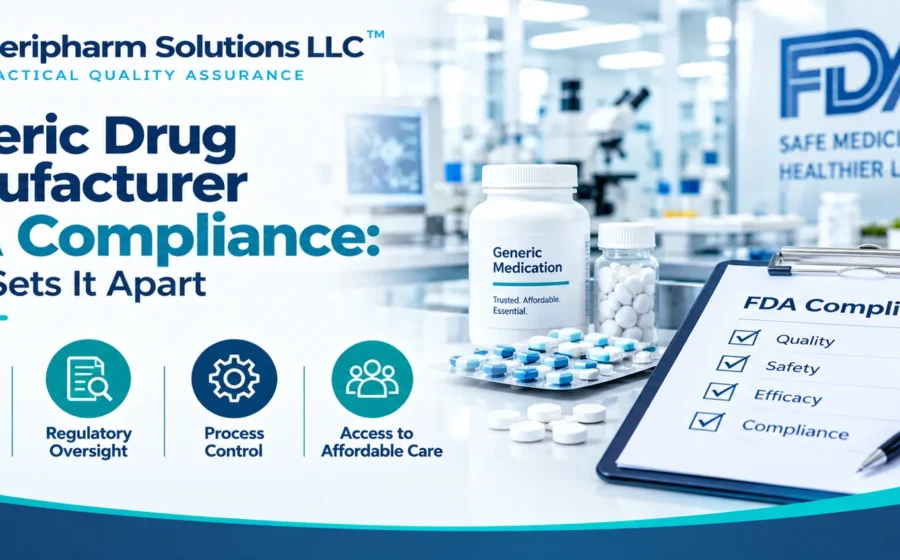
Generic drug manufacturer FDA compliance rests on two pillars: an approved Abbreviated New Drug Application (ANDA) showing the product is bioequivalent to the brand, and ongoing compliance with the same Current Good Manufacturing Practice (CGMP) rules that apply to branded manufacturers. The approval pathway is different; the manufacturing standard is not.
This guide explains which FDA requirements apply to generic drug manufacturers, what an ANDA is, whether CGMP differs for generics, and the compliance risks that tend to be more pronounced in generic manufacturing. It is written for QA, regulatory affairs, and leadership teams at generic manufacturers.
What FDA Compliance Requirements Apply Specifically to Generic Drug Manufacturers?
Generic drug manufacturers must hold an approved ANDA for each product, manufacture under CGMP per 21 CFR Parts 210 and 211, and pass FDA inspections, including pre-approval inspections of the manufacturing facility. They must also keep the product consistent with the approved application and report changes through the appropriate regulatory channels.
Definition box: Generic drug manufacturer FDA compliance = meeting both the regulatory approval requirements of the ANDA pathway and the ongoing CGMP, inspection, and post-approval change requirements that apply to every drug manufacturer.
The core compliance obligations
- ANDA approval. Demonstrate the generic has the same active ingredient, strength, dosage form, and route as the reference listed drug, and is bioequivalent.
- CGMP compliance. Follow 21 CFR Parts 210 and 211 for facilities, processes, testing, and records {external_source: FDA ANDA guidance}.
- Facility inspections. Pass pre-approval and routine surveillance inspections.
- Post-approval change management. Assess and report manufacturing, specification, and site changes according to their impact on the approved application.
- Data integrity. Keep complete, accurate, and trustworthy records for both batch and laboratory data.
Takeaway: A generic manufacturer must satisfy two regulatory layers: the ANDA that approves the product, and the CGMP system that governs how every batch is made.
What Is an ANDA?
An ANDA, or Abbreviated New Drug Application, is the application a manufacturer submits to FDA to obtain approval to market a generic drug. It is “abbreviated” because it generally relies on FDA’s earlier finding of safety and effectiveness for the brand product and does not repeat full clinical trials, but it must show the generic is pharmaceutically equivalent and bioequivalent to the reference product.
An ANDA contains information on the drug substance and product, manufacturing process and controls, specifications, stability, labeling, and bioequivalence data. The manufacturing and quality sections are the part most closely tied to CGMP and inspection readiness.
Takeaway: The ANDA shortens the clinical evidence requirement, not the manufacturing and quality requirements.
Do Generic Drug Manufacturers Follow the Same CGMP Rules as Branded Manufacturers?
Yes, generic drug manufacturers follow the same CGMP regulations as branded manufacturers. CGMP under 21 CFR Parts 210 and 211 applies to all finished pharmaceuticals regardless of whether the product is branded or generic, and FDA inspects both against the same standard.
What differs is the approval pathway and the commercial context, not the quality bar. A generic product made in a facility with serious CGMP deficiencies can face the same Form 483 observations, warning letters, and application approval holds as a branded one.
| Area | Branded (NDA) | Generic (ANDA) |
|---|---|---|
| CGMP rules | 21 CFR 210/211 | 21 CFR 210/211 (identical) |
| Approval basis | Full safety and efficacy data | Bioequivalence to reference product |
| Facility inspections | Yes, including pre-approval | Yes, including pre-approval |
| Typical pressure | Lifecycle and brand risk | Cost, speed, and volume |
Takeaway: CGMP is the same for generic and branded drugs; the differences lie in the application pathway and commercial pressures.
What Compliance Risks Are Unique to Generics?
Compliance risks that are more pronounced in generic manufacturing include cost and margin pressure that can strain quality resources, high product volume and portfolio breadth, heavy use of contract manufacturers and global suppliers, tight launch timelines tied to patent expiry, and data integrity vulnerabilities. These are tendencies, not rules, but they shape where inspectors and quality teams should look.
Risk areas to manage
- Resource strain. Lean margins can lead to understaffed QA and slow investigations.
- Portfolio breadth. Many products on shared equipment raise cross-contamination and cleaning validation demands.
- Supply chain depth. Multiple suppliers and CMOs require strong vendor qualification and audits.
- Launch pressure. Compressed timelines can cause shortcuts in validation and documentation.
- Data integrity. Incomplete or altered records are a recurring FDA concern across the industry.
- Post-approval changes. Frequent site, supplier, and process changes need disciplined change control and correct regulatory reporting.
Takeaway: Generic manufacturers face the same rules with tighter margins and timelines, so systems must be built to hold up under pressure.
How Can Generic Manufacturers Stay Inspection-Ready?
Generic manufacturers stay inspection-ready by building a CGMP quality system sized for their product portfolio, controlling changes and vendors rigorously, protecting data integrity, and rehearsing inspections before FDA arrives. Readiness is kept continuously rather than created after a notice.
Steripharm Solutions LLC, led by Pramod Sharma, Ph.D., supports manufacturers of Rx and OTC drugs across sterile and non-sterile dosage forms, with CMO partnership experience in the Americas, Europe, and India. Associate Madan Chilakuri adds regulatory affairs expertise, including successful ANDA submissions, FDA deficiency responses, and eCTD filings.
Takeaway: Inspection readiness for generics combines a right-sized quality system with regulatory submission expertise.
Frequently Asked Questions
Generic manufacturers need an approved ANDA, must manufacture under CGMP (21 CFR Parts 210 and 211), pass FDA inspections including pre-approval inspections, and manage post-approval changes correctly. Data integrity applies throughout.
No. The same CGMP regulations apply to generic and branded finished pharmaceuticals, and FDA inspects both against the same standard. Only the approval pathway differs.
The ANDA approval requirements (same active ingredient, strength, dosage form, route, and bioequivalence), plus CGMP, facility inspection, and post-approval change reporting obligations shared with all drug manufacturers.
Yes. CGMP under 21 CFR Parts 210 and 211 applies to all finished drug products regardless of whether they are branded or generic.
An Abbreviated New Drug Application is the submission to FDA for approval of a generic drug. It relies on FDA’s earlier findings for the reference product and must show pharmaceutical equivalence and bioequivalence.
Risks that tend to be more pronounced include cost pressure on quality resources, broad product portfolios on shared equipment, heavy reliance on CMOs and suppliers, compressed launch timelines, and data integrity vulnerabilities.
Bioequivalence means the generic delivers the same amount of active ingredient to the bloodstream at the same rate as the reference product, within accepted statistical limits, so it is expected to work the same way in patients.
Yes. FDA may inspect the manufacturing facility named in an ANDA before approval to verify the application data and CGMP compliance. Deficiencies can delay or block approval.
Manufacturing, specification, supplier, and site changes must go through internal change control and be reported to FDA through the category appropriate to their potential impact on product quality.
Steripharm Solutions supports quality systems, FDA compliance, and CMO partnerships for Rx and OTC manufacturers, with regulatory associate Madan Chilakuri contributing ANDA submission and FDA deficiency response experience.
Conclusion
Generic and branded manufacturers face the same CGMP standard. The difference is how the product is approved and the commercial pressures around quality. Generic manufacturers that right-size their quality systems, control changes, and protect data integrity are best positioned for inspection success.
Talk to an expert → Contact Steripharm Solutions