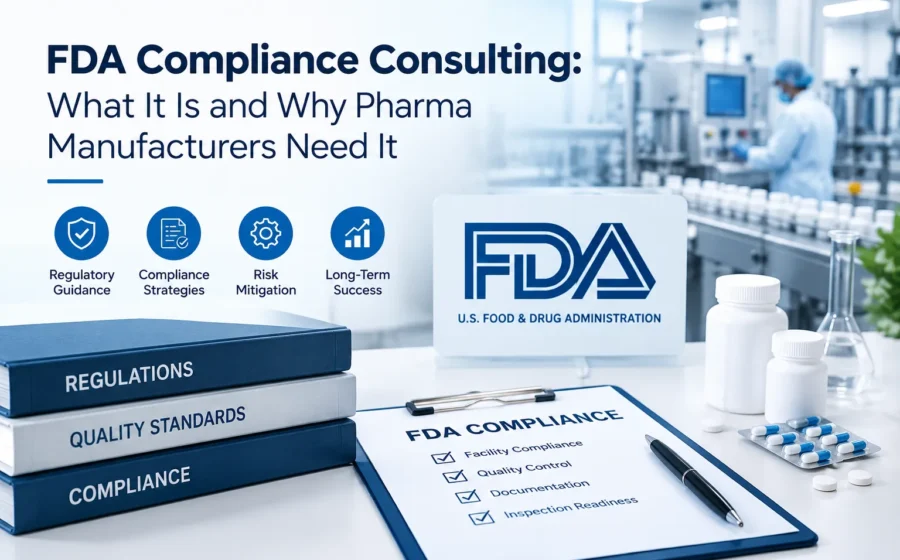
FDA compliance consulting is the practice of hiring outside regulatory and quality experts to help drug manufacturers meet FDA requirements — including Current Good Manufacturing Practice (CGMP), inspection readiness, and quality management system standards — before problems become 483 observations or warning letters. For sterile and non-sterile drug manufacturers in the USA, the cost of getting this wrong is measured in shutdown lines, delayed approvals, and recalls, not just paperwork.
This guide breaks down what FDA compliance consulting actually involves, who needs it, what it costs, and how to choose the right partner. You’ll also find direct answers to the questions pharma founders and QA/QC managers ask most often about FDA compliance consulting.
What Is FDA Compliance Consulting?
FDA compliance consulting is a professional advisory service that helps pharmaceutical and drug manufacturing companies build, audit, and maintain systems that satisfy FDA regulations under 21 CFR Parts 210 and 211. These services typically cover quality management systems, CGMP gap assessments, mock inspections, CAPA (Corrective and Preventive Action) programs, and remediation after FDA Form 483 observations or warning letters.
Definition box: FDA compliance consulting = third-party regulatory and quality expertise brought in to help a drug manufacturer identify gaps against FDA requirements, build corrective systems, and prepare for (or respond to) FDA inspections.
Unlike internal QA teams, who are often stretched across daily production issues, compliance consultants bring an outside, inspection-trained perspective. According to FDA guidance on CGMP for finished pharmaceuticals (21 CFR 211), manufacturers are expected to maintain documented, validated systems for every stage of production — from raw material testing to batch release {external_source: FDA.gov CGMP guidance}. A consultant’s job is to translate that regulatory language into operational reality on the plant floor.
Takeaway: FDA compliance consulting turns abstract regulatory text into an auditable, inspection-ready quality system — before the FDA shows up to check.
What Does an FDA Compliance Consulting Firm Do?
An FDA compliance consulting firm audits a manufacturer’s quality systems against CGMP requirements, identifies gaps, builds remediation plans, and prepares the facility and staff for FDA inspections. Firms like Steripharm Solutions also provide ongoing quality assurance support, documentation review, and mock inspection training.
In practice, this work breaks down into several recurring service categories:
- CGMP gap assessments — comparing current SOPs, batch records, and facility practices against 21 CFR 210/211 requirements.
- Mock FDA inspections — simulating an actual inspection, including interview coaching for QA/QC staff and production leads.
- 483 and warning letter remediation — building corrective action plans after an adverse FDA finding, and tracking them to closure.
- Quality Management System (QMS) design — building or upgrading document control, deviation management, and CAPA systems.
- Validation support — process validation, cleaning validation, and equipment qualification (IQ/OQ/PQ) for sterile and non-sterile lines.
- Regulatory submission support — helping prepare quality sections of ANDA, NDA, or 351(k) filings.
[Internal Link: explore our full consulting capabilities → /services/]
Takeaway: A compliance consulting firm’s core job is to close the gap between what a facility currently does and what CGMP requires — documented, tested, and defensible under inspection.
Why Do Pharma Companies Hire Compliance Consultants?
Pharma companies hire FDA compliance consultants for three main reasons: to avoid or resolve enforcement action (483s, warning letters, consent decrees), to prepare for a specific FDA inspection or product launch, and to fill an internal expertise gap that a growing manufacturer hasn’t yet built in-house.
Common triggers for hiring a consultant
- A pre-approval inspection (PAI) is scheduled for a new product.
- The facility received a Form 483 and has 15 business days to respond.
- A startup manufacturer is scaling from clinical to commercial production and has no in-house regulatory affairs head yet.
- Leadership wants an unbiased, third-party audit before self-reporting or before an acquisition due diligence review.
- The company is expanding into a new dosage form — sterile injectables, ophthalmic, otic, transdermal — that requires specialized expertise the current team doesn’t have.
That last point matters more than it might seem. A QA manager who has spent a career in oral solid dosage manufacturing does not automatically have the aseptic processing, environmental monitoring, or media fill expertise that sterile injectable manufacturing demands. Bringing in a consultant with cross-modality experience closes that gap quickly, rather than over months of trial and error under inspection pressure.
Takeaway: Companies hire compliance consultants when the cost of an in-house learning curve — measured in inspection risk — is higher than the cost of outside expertise.
Who Needs FDA Compliance Consulting?
FDA-regulated drug manufacturers of all sizes need compliance consulting at some stage — but the need is most acute for companies without a fully built-out internal regulatory affairs and quality function. This includes early-stage pharma founders scaling a first product, contract manufacturers adding new lines, and established facilities responding to an FDA finding.
| Company Profile | Typical Compliance Need |
|---|---|
| Pharma startup, first commercial product | QMS build-out, pre-approval inspection prep |
| Contract manufacturer (CDMO/CMO) | Multi-client audit readiness, SOP standardization |
| Established manufacturer, post-483 | Remediation plan, CAPA tracking, re-inspection prep |
| Facility adding sterile injectable line | Aseptic processing validation, environmental monitoring program |
| Company preparing for acquisition | Third-party compliance due diligence |
Steripharm Solutions, founded by Pramod Sharma, Ph.D., works across this full spectrum — supporting sterile injectables, ophthalmic and otic products, oral dosage forms, and transdermal products for manufacturers across the Americas, Europe, and India. That cross-modality, cross-region experience is what lets a consulting team spot risks a single-facility internal team might miss.
Takeaway: If a company doesn’t have a dedicated, inspection-experienced regulatory affairs head on staff, it likely needs FDA compliance consulting at some point in its product lifecycle.
How Much Does FDA Compliance Consulting Cost?
FDA compliance consulting costs vary widely based on scope — a single mock inspection or gap assessment may be a fixed-fee engagement, while ongoing QMS support or 483 remediation is typically billed hourly or as a retainer over several months. Exact pricing depends on facility size, dosage form complexity, and the severity of any existing compliance findings.
Rather than publish a generic number that won’t reflect your facility’s actual scope, most reputable firms — including Steripharm — provide a scoped quote after an initial consultation, since a sterile injectable line with an open 483 requires materially different resourcing than a routine annual gap assessment for an oral solid dosage plant.
Takeaway: FDA compliance consulting cost is scope-driven, not flat-rate — get a specific quote based on your facility type and current compliance status rather than relying on industry averages.
How Do I Choose an FDA Compliance Consultant?
Choose an FDA compliance consultant based on documented inspection experience, dosage-form-specific expertise, and a track record with facilities like yours — not just general regulatory knowledge. Ask for references, prior 483/warning letter resolution outcomes, and specifics on the modalities (sterile, non-sterile, transdermal) they’ve supported.
A practical checklist
- Inspection track record: Have they directly supported companies through FDA inspections, not just paper audits?
- Dosage form depth: Sterile injectables, ophthalmic/otic, and transdermal products each carry distinct regulatory expectations — confirm direct experience in your modality.
- Global exposure: Firms with experience across the Americas, Europe, and India often bring broader pattern-recognition on inspection trends and enforcement priorities.
- Founder/leadership credentials: Look for a named, credentialed leader — for example, Steripharm Solutions is led by Pramod Sharma, Ph.D., which gives clients a clear point of accountability rather than an anonymous consulting bench.
- Clear scope and deliverables: A credible proposal should define specific deliverables (gap report, CAPA plan, mock inspection debrief) rather than open-ended “advisory hours.”
Takeaway: The right FDA compliance consultant is defined by verifiable inspection experience in your specific dosage form — not by the size of the firm’s marketing budget.
Frequently Asked Questions
FDA compliance consulting is a service where regulatory and quality experts help drug manufacturers meet FDA requirements under CGMP (21 CFR 210/211). It typically includes gap assessments, mock inspections, CAPA planning, and remediation support after 483 observations or warning letters.
Any FDA-regulated drug manufacturer without a fully built internal regulatory affairs function needs it — especially startups launching a first product, CDMOs adding lines, and facilities responding to an FDA finding. It’s also valuable when a company enters a new dosage form, like sterile injectables, without prior in-house expertise.
Costs vary by scope: a single gap assessment or mock inspection is often fixed-fee, while ongoing QMS support or 483 remediation is typically hourly or retainer-based over months. Facility size, dosage form complexity, and existing compliance issues all affect the final quote.
Choose based on documented FDA inspection experience, dosage-form-specific expertise, and named leadership credentials — not general regulatory knowledge alone. Ask for references and specific outcomes from prior 483 or warning letter engagements before signing.
CGMP (Current Good Manufacturing Practice) is the set of FDA regulations under 21 CFR Parts 210 and 211 that govern how drugs must be manufactured, tested, and documented. It covers facility controls, equipment qualification, personnel training, batch records, and quality systems for every dosage form.
A Form 483 is a written notice an FDA investigator issues at the end of an inspection listing observed CGMP deviations. It is not a final enforcement action, but manufacturers are expected to respond in writing, usually within 15 business days, with a documented corrective action plan.
If violations are serious enough, the FDA can escalate from a Form 483 to a warning letter, import alert, or consent decree, any of which can halt production or U.S. distribution. Timely, well-documented CAPA responses after an inspection are what typically prevent that escalation.
Engagement length depends on scope — a mock inspection or gap assessment can be completed in a few weeks, while full QMS build-outs or 483 remediation programs often run three to twelve months. Facility complexity and the number of open findings are the main factors that determine timeline.
Yes — internal QA manages day-to-day production quality, while compliance consulting provides an outside, inspection-trained review of whether those internal systems actually meet CGMP requirements. Many manufacturers use consultants to validate or strengthen an existing QA function rather than replace it.
Yes, Steripharm Solutions supports sterile injectable manufacturers alongside ophthalmic, otic, oral dosage, and transdermal product lines. This cross-modality experience, spanning the Americas, Europe, and India, is central to how the firm identifies dosage-form-specific compliance risks.
Most manufacturers run internal CGMP audits at least annually, with additional mock inspections before any scheduled FDA visit or major product launch. Facilities with a recent 483 or warning letter typically increase audit frequency until CAPA items are fully closed.
Conclusion
FDA compliance consulting isn’t a one-time checkbox — it’s an ongoing partnership that keeps a manufacturer inspection-ready as products, lines, and regulations evolve. Whether you’re preparing for a first pre-approval inspection or responding to a 483, the right compliance partner brings pattern-recognition your internal team hasn’t had the chance to build yet.
Steripharm Solutions LLC, led by Pramod Sharma, Ph.D., supports sterile injectable, ophthalmic/otic, oral dosage, and transdermal manufacturers across the Americas, Europe, and India with hands-on FDA compliance consulting, quality management system design, and inspection readiness support.
Talk to an expert → Contact Steripharm Solutions