The difference between QA and QC in pharma comes down to scope: Quality Assurance (QA) provides system-level oversight ensuring the entire process is built to produce quality products, while Quality Control (QC) focuses on testing and verifying that specific materials, in-process samples, and finished products actually meet specification. Both functions are essential, and confusing them — or structuring one to report into the other — is a common source of CGMP findings.
This guide breaks down what QA and QC each actually do, where their responsibilities diverge and overlap, and how they work together within a pharmaceutical quality system. You’ll also find direct answers to the questions students, QA/QC managers, and pharma leadership ask most about QA vs QC in pharma.
What Is the Difference Between QA and QC in Pharma?
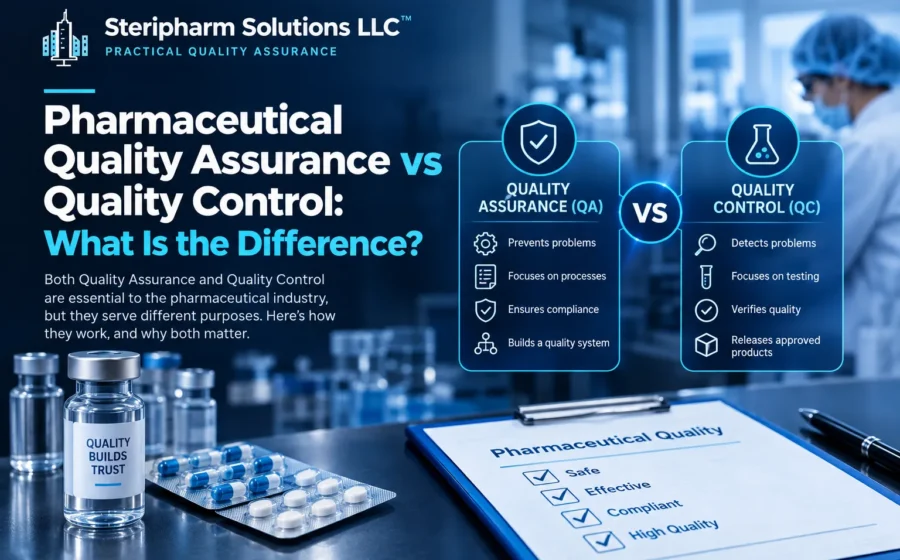
QA provides system-level oversight and assurance that processes, procedures, and documentation are designed and followed correctly, while QC focuses on testing and laboratory controls that verify materials and products meet specification. In short: QA builds and oversees the system that should produce a quality product; QC checks whether a specific batch, sample, or material actually did.
Definition box: Quality Assurance (QA) = the proactive, system-wide function ensuring processes, procedures, and documentation are designed, followed, and maintained to consistently produce quality drug products. Quality Control (QC) = the reactive, testing-based function that verifies raw materials, in-process samples, and finished products meet defined specifications.
ICH Q10 describes the pharmaceutical quality system as encompassing both functions, with QA typically holding broader oversight authority, including the final decision on batch release {external_source: ICH Q10}. FDA’s CGMP Q&A guidance similarly treats QA and QC as distinct but interdependent parts of the same “quality unit” required under 21 CFR 211.
Takeaway: QA is about whether the system is designed and followed correctly; QC is about whether a specific sample or batch actually meets specification — both are necessary, and neither substitutes for the other.
QA vs QC: Responsibilities Compared
| Aspect | Quality Assurance (QA) | Quality Control (QC) |
|---|---|---|
| Primary focus | System, process, and documentation oversight | Testing materials, samples, and finished product |
| Approach | Proactive — prevents defects through design and process control | Reactive — detects defects through testing and inspection |
| Typical activities | SOP approval, deviation and CAPA oversight, batch disposition, audits | Raw material testing, in-process testing, stability testing, finished product release testing |
| Where it sits | Oversees the whole quality system across departments | Operates primarily within the laboratory |
| Key output | Batch release decision, approved SOPs, closed CAPA | Certificate of Analysis, test results, pass/fail data |
| CGMP reference point | Broader 21 CFR 211 quality unit responsibilities | 21 CFR 211 Subpart I (laboratory controls) specifically |
Takeaway: QA sits above the whole production and testing process as an oversight function, while QC sits inside the laboratory, generating the specific test data QA relies on to make release decisions.
What Does QA Actually Do?
QA is responsible for approving SOPs and specifications, overseeing deviation investigations and CAPA, conducting internal audits, managing change control, and making the final batch disposition decision. QA doesn’t typically perform the tests themselves — it reviews whether the testing, documentation, and process controls behind a batch were all executed correctly before authorizing release.
Core QA responsibilities
- Document and SOP approval — reviewing and approving procedures before they go into use.
- Deviation and CAPA oversight — ensuring investigations are thorough and corrective actions are effective, not just documented.
- Internal audits — independently assessing whether departments are actually following approved procedures.
- Change control — evaluating and approving changes to process, equipment, or documentation before implementation.
- Batch disposition — the final decision to release, reject, or quarantine a batch based on the complete record, including QC test results.
Takeaway: QA’s authority is broad but largely oversight-based — it approves, investigates, and ultimately decides, but relies on QC’s test data as one input among several.
What Does QC Actually Do?
QC is responsible for testing raw materials, in-process samples, and finished products against defined specifications, and for generating the data — Certificates of Analysis, stability results, environmental monitoring data — that QA reviews before making a release decision. QC operates primarily within the laboratory and reports objective, measurable results rather than making disposition decisions.
Core QC responsibilities
- Raw material testing — confirming incoming materials meet identity, purity, and quality specifications before use.
- In-process testing — checking product at defined stages of manufacturing to confirm the process is performing as validated.
- Finished product testing — testing the final product against its full specification before it’s eligible for release.
- Stability testing — monitoring product quality over time under defined storage conditions.
- Environmental and microbiological monitoring — particularly critical for sterile injectable manufacturing, where QC tracks cleanroom and process contamination risk.
[Internal Link: see how QA and QC fit into a full CGMP QMS → /cgmp-quality-management-system-components/]
Takeaway: QC’s job ends at generating accurate, reliable test data — it’s QA’s job to interpret that data in the context of the full batch record and decide whether the product can be released.
Is QA Higher Than QC?
In most pharmaceutical organizations, QA holds broader authority than QC, since QA makes the final batch disposition decision and oversees the systems QC operates within — but this isn’t a strict hierarchy in every company, and QC leadership often reports at a similarly senior level. What matters more than titles is that QA and QC remain functionally independent from production, with QA holding final release authority.
FDA’s CGMP requirements center on the independence of the “quality unit” from production, not on a specific reporting structure between QA and QC. Some organizations run QA and QC as a single quality unit with sub-functions; others separate them into distinct departments reporting to a shared quality leader. Either structure can be CGMP-compliant, provided the release decision authority remains independent of production pressure.
Takeaway: QA typically has broader authority because it holds final release decisions, but the more important compliance question is whether the quality function — QA and QC together — remains independent from production.
How Do QA and QC Work Together?
QA and QC work together through a continuous feedback loop: QC generates test data at each stage of production, and QA reviews that data alongside process records, deviations, and documentation to make batch disposition decisions and to identify systemic issues that need broader corrective action. Neither function can operate effectively in isolation from the other.
Where QA and QC intersect
- Specification setting — QA and QC typically collaborate to define test specifications that are both scientifically sound and operationally testable.
- Investigations — an out-of-specification (OOS) result identified by QC triggers a QA-overseen investigation into root cause.
- Batch release — QA reviews the complete batch record, including all QC test results, before making the final disposition decision.
- Trend analysis — QA uses QC data over time to identify process drift or recurring quality issues that individual test results wouldn’t reveal alone.
- Audit and inspection readiness — QA and QC jointly prepare for FDA inspections, since investigators routinely trace a batch record through both functions.
Takeaway: QA and QC function as one connected system in practice — QC’s test data feeds QA’s oversight decisions, and QA’s investigations often send issues back to QC to confirm whether a testing or process gap was the underlying cause.
Frequently Asked Questions
QA provides system-level oversight of processes, procedures, and documentation, while QC focuses on testing materials and products against specification. QA is proactive and prevention-focused; QC is reactive and detection-focused, generating the test data QA relies on for release decisions.
In most organizations, QA holds broader authority since it makes the final batch disposition decision and oversees the systems QC works within, but this isn’t a universal hierarchy. What matters most for CGMP compliance is that the combined quality function remains independent from production, not the specific reporting structure between QA and QC.
QC generates test data at each production stage, and QA reviews that data alongside process records and documentation to make release decisions and identify systemic issues. An out-of-specification result from QC, for example, triggers a QA-overseen root-cause investigation.
QA and QC responsibilities map directly onto several QMS components — QA handles document control, deviations, CAPA, change control, and batch disposition, while QC’s work generates the test data that supports batch disposition. Both functions operate within the same overall quality management system framework.
In very small or early-stage manufacturers, it’s possible for overlapping responsibilities to exist temporarily, but FDA still expects functional independence for the batch release decision from anyone directly involved in producing or testing that batch. As a company scales, most manufacturers separate QA and QC into distinct roles or teams specifically to maintain that independence.
No — QC generates and reports test data, but the final batch disposition decision is a QA responsibility under CGMP requirements. This separation exists specifically so the release decision considers the full context (deviations, documentation, process history), not test results in isolation.
Laboratory controls are addressed specifically under 21 CFR 211 Subpart I, which covers testing and release requirements for components, containers, and finished products. QA’s broader responsibilities are addressed across other subparts of 21 CFR 211 covering organization, buildings, and records.
Independence prevents production timelines or cost pressure from influencing testing results or release decisions, which is central to why FDA requires the quality unit to be organizationally separate from manufacturing. A QA or QC function that reports into production leadership creates an inherent conflict of interest that inspectors specifically look for.
Not necessarily — many professionals move between QA and QC roles over a career, though QC often draws more heavily on laboratory and analytical chemistry skills, while QA leans more on process, documentation, and regulatory knowledge. Both roles require a solid grounding in CGMP requirements regardless of the specific technical background.
For sterile injectables, QC’s scope expands to include environmental and microbiological monitoring, media fill testing, and sterility testing, while QA’s oversight extends to aseptic process validation and contamination control strategy. The stakes for both functions are higher, since a QA or QC gap in a sterile line can directly translate to patient safety risk.
Conclusion
QA and QC aren’t competing functions — they’re two halves of the same quality system, one focused on building and overseeing the process, the other on verifying it actually worked. Manufacturers that treat them as genuinely interdependent, rather than siloed departments, tend to have stronger inspection outcomes and fewer recurring deviations.
Steripharm Solutions LLC, led by Pramod Sharma, Ph.D., helps sterile injectable, ophthalmic/otic, oral dosage, and transdermal manufacturers across the Americas, Europe, and India strengthen the QA/QC relationship as part of a fully integrated quality management system.
Learn more about our QA/QC consulting → Steripharm Quality Assurance Services