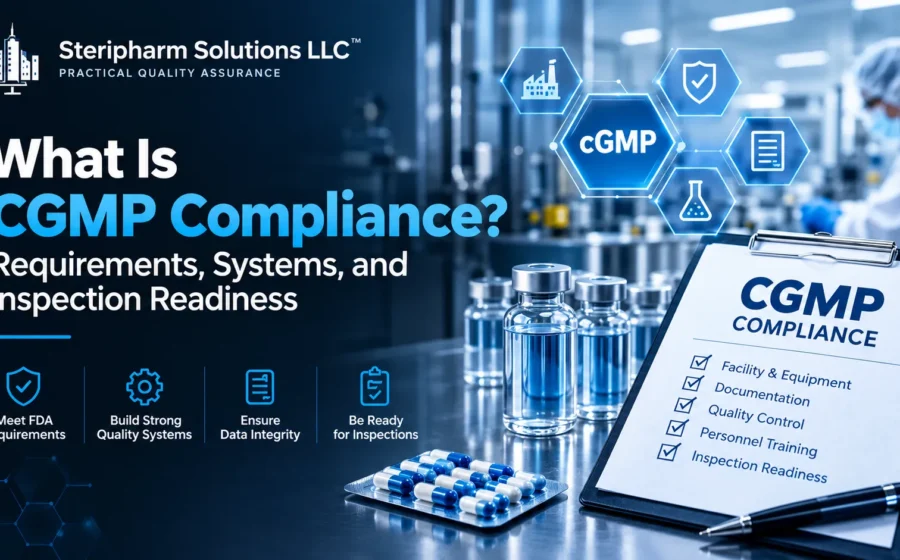
CGMP compliance sits at the center of nearly every conversation about drug quality in the United States. It’s referenced in inspection reports, cited in Warning Letters, and built into the daily language of quality teams — but the term itself covers a lot of ground. This guide walks through what CGMP compliance actually requires, how the regulation breaks down by function, and what it takes to stay compliant between inspections rather than scrambling before them.
What Does CGMP Compliance Mean?
CGMP stands for Current Good Manufacturing Practice. CGMP compliance means a drug manufacturer operates its facilities, personnel, equipment, processes, materials, and records in accordance with FDA’s current good manufacturing practice requirements, set out primarily in 21 CFR Part 211 for finished pharmaceuticals (with Part 210 providing the general definitions and applicability).
The word “current” is doing real work in that name. CGMP isn’t a fixed checklist — it’s a standard that assumes manufacturers keep pace with evolving technology, quality systems thinking, and industry practice, not just the minimum written into the regulation years ago.
At its core, CGMP compliance is about one thing: consistently producing drug products that meet their identity, strength, quality, and purity specifications, batch after batch, with documented evidence to prove it.
The Regulatory Foundation: 21 CFR Parts 210 and 211
Part 211 organizes CGMP requirements into distinct subparts covering organization and personnel, buildings and facilities, equipment, control of components and containers, production and process controls, packaging and labeling, holding and distribution, laboratory controls, records and reports, and returned or salvaged drug products.
Two things are worth understanding about how this regulation functions in practice:
- It’s outcome-focused, not prescriptive to the letter. FDA generally does not tell a manufacturer exactly which equipment to buy or which software to use. It specifies the outcome — for example, that equipment must be suitable for its intended use and maintained on an appropriate schedule — and leaves the specific implementation to the manufacturer.
- It’s enforced through documentation. An activity that isn’t documented is, from an inspection standpoint, an activity that didn’t happen. This is why recordkeeping shows up as heavily in CGMP enforcement actions as any technical failure.
The Core Areas of CGMP Requirements
Facilities and Equipment
Manufacturing facilities must be designed, maintained, and cleaned in a way that prevents contamination and mix-ups. This includes appropriate space for operations, environmental controls, and equipment that’s qualified for its intended use and maintained on a documented schedule.
Personnel
CGMP requires that personnel involved in manufacturing, processing, packing, or holding a drug product have the education, training, and experience to perform their assigned functions — and that this training is documented and ongoing, not a one-time onboarding event.
Materials and Components
Raw materials, components, and containers must be tested or verified against specifications before use, tracked through the manufacturing process, and controlled to prevent the use of rejected or expired materials.
Production and Process Controls
This is where much of CGMP enforcement activity concentrates. Manufacturing processes must be validated, controlled, and monitored, with in-process controls to detect deviations before they affect finished product. Batch records document that each step of the process was actually followed as written.
Laboratory Controls
Laboratories must use scientifically sound, validated test methods to confirm that materials and finished products meet specifications. Out-of-specification (OOS) results require a documented investigation, not just a retest until an acceptable number appears.
Documentation and Records
Every one of the areas above depends on documentation that is accurate, complete, and contemporaneous. Batch records, SOPs, validation reports, and deviation logs form the evidentiary backbone of a CGMP-compliant operation — and they’re typically the first thing an FDA investigator reviews.
How CGMP Fits Into a Broader Quality Management System
CGMP compliance isn’t just a set of individual requirements to check off — it functions best as part of a connected pharmaceutical quality management system (QMS). A mature QMS ties together change control, deviation management, CAPA (corrective and preventive action), risk management, and management review so that issues in one area surface and get addressed system-wide, rather than staying isolated within a single department.
Manufacturers that treat CGMP as a series of disconnected compliance tasks tend to struggle more during inspections, because investigators are specifically trained to trace whether a deviation in one area was properly evaluated for its impact elsewhere. For a deeper look at how these components fit together, see our guide to CGMP quality management system components.
How Manufacturers Maintain CGMP Compliance
Staying CGMP compliant is an ongoing discipline rather than a project with an end date. Practices that support sustained compliance include:
- Internal audits and self-inspections conducted on a regular schedule, not just ahead of an expected FDA visit
- A functioning quality unit with the authority to hold or reject batches, independent of manufacturing and business pressure
- Timely deviation investigations that identify root cause rather than closing out paperwork
- Change control processes that evaluate the downstream impact of any change to process, equipment, or materials
- Periodic product quality reviews that look for trends across batches, not just pass/fail results on individual lots
- Ongoing training that keeps pace with procedure updates and regulatory changes
Consistency matters more than any single strong quarter. FDA investigators are looking at trends over time — a facility with a strong quality system shows steady, well-documented performance rather than a rush of remediation activity right before an inspection.
Inspections and CGMP
FDA conducts CGMP inspections on a risk-based schedule, and investigators use a systems-based approach that examines the quality system alongside production, facilities and equipment, materials, laboratory controls, and packaging/labeling systems. A weakness identified in the quality system itself — the system meant to catch and correct problems — tends to draw the most serious scrutiny, since it calls into question the reliability of everything else.
What Happens If a Facility Is Not CGMP Compliant?
Noncompliance findings escalate in a fairly predictable sequence:
- Form 483 observations — issued at the end of an inspection when an investigator identifies conditions that may violate CGMP requirements. A 483 is not itself a legal action, but a timely, well-documented response matters.
- Warning Letter — issued when FDA determines that violations are significant enough to warrant a formal notice, typically after an inadequate 483 response or more serious findings.
- Consent decree, import alert, or product seizure — reserved for cases involving persistent noncompliance, significant public health risk, or failure to adequately remediate after a Warning Letter.
The cost of noncompliance extends beyond the direct regulatory consequence. Remediation is expensive and time-consuming, and consequences can include product recalls, halted approvals for new products, and lasting damage to customer and partner confidence.
FAQ
CGMP compliance means a drug manufacturer’s facilities, personnel, processes, materials, and records meet FDA’s current good manufacturing practice requirements under 21 CFR Part 211, ensuring consistent product identity, strength, quality, and purity.
Core requirement areas include facilities and equipment, personnel qualification and training, control of materials and components, production and process controls, laboratory controls, and documentation and recordkeeping.
Manufacturers maintain compliance through regular internal audits, an independent quality unit, timely deviation investigations, structured change control, periodic product quality reviews, and ongoing staff training — treated as continuous practices rather than one-time projects.
Noncompliance can result in Form 483 observations, a Warning Letter, and in more serious or unresolved cases, a consent decree, import alert, or product seizure — along with the operational cost of remediation and potential recalls.
For a closer look at the individual pieces that make up a compliant quality system, see our guide to CGMP quality management system components. If your team is preparing for an inspection or working through a compliance gap, our FDA compliance consulting services can help you build a plan.