Knowing how to respond to an FDA Form 483 starts with understanding the clock is already running: FDA expects a written response within 15 business days, and that response is often what determines whether the observation stays a 483 or escalates into a warning letter. A rushed, defensive, or incomplete response is one of the most common reasons a facility ends up with more serious enforcement action.
This guide walks through the exact steps a manufacturer should take after receiving a Form 483 — from the moment the investigator hands it over to closing out the last CAPA item. You’ll also find direct answers to the most common questions manufacturers ask about Form 483 response.
How Do I Respond to an FDA Form 483?
Responding to an FDA Form 483 means submitting a written, item-by-item reply within 15 business days that acknowledges each observation, explains the root cause, and details a specific, time-bound corrective action plan. FDA does not require a response, but the agency’s own Investigations Operations Manual notes that a prompt, credible response is a key factor in deciding whether further action is warranted
Definition box: FDA Form 483 response = a written communication from a manufacturer to the FDA district office, addressing each listed observation individually with root-cause analysis, corrective actions, preventive actions, and implementation timelines.
A strong response does three things at once: demonstrates the company understands why each deviation occurred, proves corrective action is already underway (not just planned), and shows the fix addresses the root cause rather than just the symptom the investigator observed.
Takeaway: An FDA Form 483 response is judged less on tone and more on evidence — specific root causes, specific actions already taken, and specific completion dates.
Step-by-Step: How to Respond to a Form 483
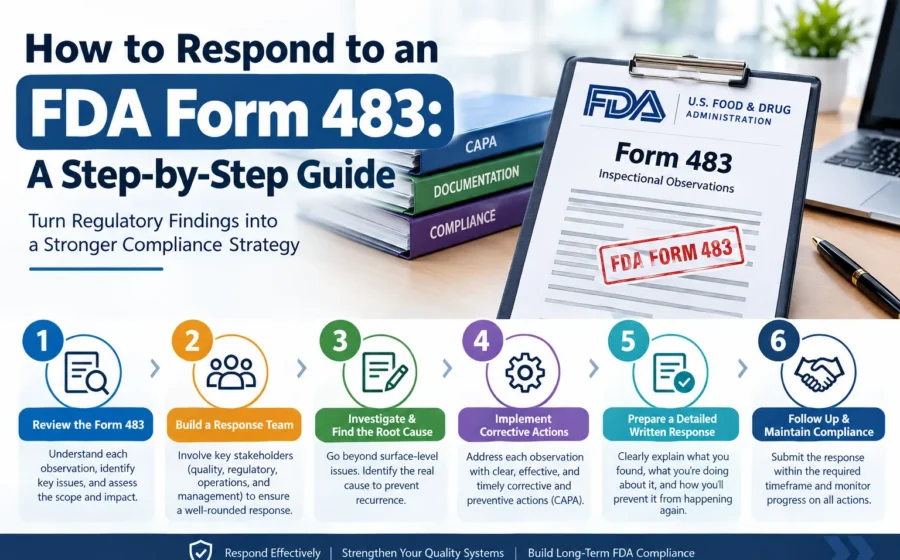
Step 1: Don’t sign or argue with the 483 on the spot
The Form 483 is a factual list of observations, not a citation to be negotiated during the closeout meeting. Acknowledge receipt, ask clarifying questions if an observation is ambiguous, and avoid arguing the investigator’s findings in the room — those conversations belong in the written response, backed by documentation.
Step 2: Assemble a cross-functional response team within 24–48 hours
Pull together QA, the relevant production or lab leads, and regulatory affairs (or an outside consultant) immediately. Delay at this stage eats directly into the 15-business-day window and often results in a rushed, weaker response later.
Step 3: Investigate root cause for every observation
Each observation needs its own root-cause investigation — not a shared, generic explanation across multiple findings. FDA investigators and reviewers can typically tell when a root cause is copy-pasted rather than specific to the finding.
Step 4: Draft corrective and preventive actions with real timelines
For each observation, document what will change (corrective action), what will prevent recurrence (preventive action), and a specific completion date — not “in progress” or “ongoing.” Where possible, note which actions are already complete at the time of submission.
Step 5: Have QA and regulatory leadership review before submission
A response should be reviewed by someone who wasn’t involved in the original deviation, to catch gaps, vague language, or unsupported claims before the letter goes out. This is also the stage where an outside consultant’s inspection-trained perspective typically adds the most value.
Step 6: Submit within 15 business days, in writing, to the district office
Submit the response to the FDA district office listed on the Form 483, in writing, referencing the establishment inspection and each observation number directly. Keep a complete copy of the submission and all supporting documentation.
Step 7: Track every CAPA item to closure and be ready to show evidence
A written commitment isn’t the end of the process — FDA can and does follow up to verify that committed actions were actually completed on schedule. Maintain a tracking log with evidence (updated SOPs, training records, validation data) for every item.
[Internal Link: request Form 483 remediation support → /services/fda-compliance/]
Takeaway: A defensible Form 483 response is built observation-by-observation, with root cause, corrective action, and a real date for each — generic or rushed responses are what typically invite further FDA scrutiny.
How Many Days Do You Have to Respond to a Form 483?
Manufacturers have 15 business days from the end of the FDA inspection to submit a written response to a Form 483. This isn’t a hard legal deadline, but FDA explicitly considers whether a response was received within this window when deciding whether to escalate to a warning letter.
Missing the 15-business-day window doesn’t disqualify a response, but a late or incomplete reply is one of the clearest signals FDA uses to judge whether a facility takes CGMP seriously. Manufacturers who need more time for a thorough root-cause investigation can request an extension, but should still submit an interim response acknowledging the observations and outlining next steps within the original window.
Takeaway: 15 business days is the practical deadline that matters — even a strong root-cause investigation looks weaker to FDA if the response itself is late or silent.
What Should a Form 483 Response Include?
A complete Form 483 response should include a cover letter, an item-by-item reply to every observation, documented root-cause analysis, specific corrective and preventive actions with completion dates, and supporting evidence such as revised SOPs or training records where available.
Core components of a strong response
- Cover letter — acknowledges the inspection, references the Form 483 date, and summarizes the company’s commitment to addressing every observation.
- Observation-by-observation reply — each numbered finding addressed individually, never grouped or summarized together.
- Root-cause analysis — a documented investigation explaining why each deviation occurred, not just what happened.
- Corrective and preventive actions (CAPA) — specific actions with named owners and completion dates.
- Supporting evidence — updated SOPs, training completion records, validation data, or photos of corrected facility conditions, where already available.
- Interim containment actions — any immediate steps taken to prevent the same issue from affecting product already in the supply chain.
Takeaway: A Form 483 response is judged on specificity — vague commitments to “review and update procedures” carry far less weight than a dated, owner-assigned action plan with evidence attached.
Can a Form 483 Turn Into a Warning Letter?
Yes, a Form 483 can escalate into a warning letter if FDA determines the observations are serious, the company’s response was inadequate or late, or similar issues were previously identified and not corrected. The response itself is often the deciding factor between the two outcomes.
FDA’s internal review typically weighs the severity of the underlying CGMP deviation alongside the quality of the manufacturer’s response — a facility with serious findings but a fast, thorough, well-documented response can sometimes avoid a warning letter, while a facility with moderate findings and a weak response may not. Repeat observations from a prior inspection significantly increase escalation risk, since they suggest the earlier CAPA wasn’t effective.
Takeaway: Whether a 483 escalates to a warning letter depends as much on the quality and speed of the response as on the severity of the original observations.
Frequently Asked Questions
You have 15 business days from the end of the FDA inspection to submit a written response. This isn’t a strict legal deadline, but FDA weighs response timing when deciding whether to escalate enforcement action.
A complete response includes a cover letter, an item-by-item reply to every observation, documented root-cause analysis, specific corrective and preventive actions with completion dates, and supporting evidence where available. Each observation should be addressed individually rather than grouped together.
Yes, escalation happens when observations are serious, the response is inadequate or late, or similar issues were previously identified and not corrected. The quality and speed of the manufacturer’s response significantly influences whether escalation occurs.
The practical window is 15 business days from the end of the inspection, though it’s not a hard statutory deadline. Manufacturers needing more time should still submit an interim acknowledgment within that window while completing a fuller investigation.
Ignoring a Form 483 significantly raises the likelihood of escalation to a warning letter, import alert, or further enforcement action, since FDA has no evidence the manufacturer is addressing the observations. It also removes the opportunity to shape FDA’s understanding of the root cause before the agency makes its own determination.
It’s not legally required, but many manufacturers bring in a regulatory consultant or attorney, especially for serious or repeat observations, since a poorly framed response can worsen the outcome. A consultant with direct inspection experience often identifies root causes and response gaps an internal team under time pressure may miss.
No — response detail should scale with the severity and complexity of each observation, but every observation still needs an individual root cause, action, and date. A minor documentation gap and a major aseptic processing deviation warrant proportionally different depth, not different structure.
Yes, manufacturers can request additional time for a thorough root-cause investigation, but it’s best practice to still submit an interim response within the original 15-business-day window. An interim response should acknowledge each observation and outline the investigation timeline, even if final CAPA details aren’t ready yet.
A Form 483 lists an investigator’s observations at the end of an inspection and is not itself a formal enforcement action, while a warning letter is a formal FDA notice indicating the agency believes violations are serious enough to warrant regulatory action if not corrected. A warning letter typically follows an inadequate response to a prior 483 or a serious, standalone finding.
Yes, FDA can follow up through a subsequent inspection, correspondence requesting evidence, or by reviewing committed actions during the next routine inspection. Manufacturers should keep documented evidence for every committed CAPA item, since FDA may verify completion well after the original response was submitted.
Conclusion
A Form 483 response is a narrow window to shape how FDA interprets your facility’s commitment to CGMP — and specificity, speed, and evidence matter more than tone. The manufacturers who avoid escalation to a warning letter are almost always the ones who treat every observation individually, with a real root cause and a real date attached.
Steripharm Solutions LLC, led by Pramod Sharma, Ph.D., helps sterile injectable, ophthalmic/otic, oral dosage, and transdermal manufacturers across the Americas, Europe, and India build defensible Form 483 responses and track CAPA items through to closure.
Talk to an expert → Contact Steripharm Solutions