The first thing a manufacturer should do after receiving an FDA Form 483 is assemble the investigation and response team within 24–48 hours, since the clock on a credible, evidence-backed response starts immediately, not once drafting begins. FDA’s March 2026 draft guidance, “Responding to FDA Form 483 Observations at the Conclusion of a Drug CGMP Inspection,” now spells out in unusual detail what the agency expects a response to contain — and that level of specificity changes how manufacturers should prepare from day one.
This guide walks through what a Form 483 actually is, the immediate actions to take, how to build an observation-by-observation response, and what FDA’s new draft guidance changes about CAPA, risk assessment, and executive accountability. You’ll also find direct answers to the questions manufacturers ask most after receiving a Form 483.
What Is an FDA Form 483?
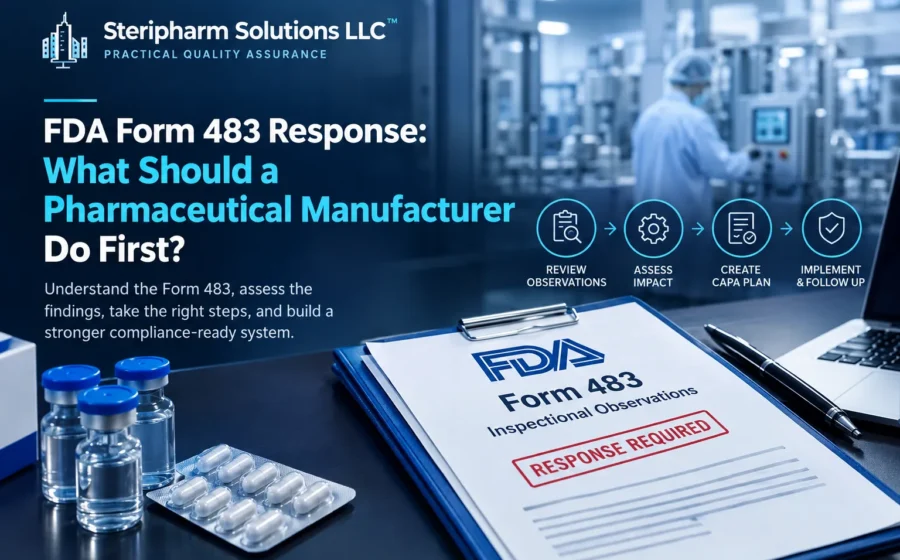
A Form 483 is a written notice an FDA investigator issues at the conclusion of an inspection, listing conditions or practices the investigator judges may violate CGMP requirements under the Federal Food, Drug, and Cosmetic Act. It is not a final compliance determination or enforcement action — FDA still needs to evaluate the observations and, if a written response is submitted, that response itself becomes part of the agency’s assessment.
Form 483 vs. Warning Letter: what’s the difference?
A Form 483 and a warning letter are not the same thing, and confusing the two leads manufacturers to under- or over-react at the wrong stage.
| Form 483 | Warning Letter | |
|---|---|---|
| When issued | At the conclusion of an inspection, on-site | After FDA reviews inspection findings and any 483 response, separately |
| Legal status | Investigator’s observations; not a final determination | Formal FDA notice that violations may warrant regulatory action |
| Response window | 15 business days (per March 2026 draft guidance) | 15 working days |
| Public visibility | Not published in FDA’s public database | Published in FDA’s public Warning Letter database |
| Typical trigger for the next one | Inspection findings | Serious findings or an inadequate/absent 483 response |
Takeaway: A Form 483 is the investigator’s on-site observation list; a warning letter is a separate, later, and more formal enforcement step that a weak 483 response makes more likely.
What Should You Do After Receiving an FDA Form 483?
The immediate priorities after receiving a Form 483 are: don’t argue with or sign off on the observations during the closeout meeting, notify executive management the same day, and assemble a cross-functional investigation team — QA, the affected production or lab area, and regulatory affairs — within 24 to 48 hours. FDA’s March 2026 draft guidance specifically calls for executive management accountability in the eventual response, which makes early leadership involvement a practical necessity, not just good practice {external_source: FDA Form 483 FAQ; March 2026 draft guidance}.
First actions, in order
- Acknowledge, don’t argue, at the closeout meeting. Ask clarifying questions if an observation is ambiguous; save substantive disagreement for the written response.
- Notify executive management immediately. The draft guidance expects the final response to be signed by someone with the authority to allocate resources and ensure commitments are met — that person needs to be looped in from day one.
- Assemble the investigation team within 24–48 hours. Include QA, the relevant operational area, and regulatory affairs or an outside consultant.
- Preserve records and begin scoping each observation. Identify affected products, lots, and any related systemic issues before drafting begins.
- Take interim containment action where needed. Any immediate step to prevent the same issue from affecting product already in the supply chain should start right away, not wait for the final CAPA plan.
Takeaway: The manufacturers who avoid escalation are the ones who start scoping and assigning ownership within 48 hours — not the ones who wait until drafting begins to figure out who’s responsible for what.
How Long Do You Have to Respond?
Manufacturers have 15 business days from receipt of the Form 483 to submit a written response, and FDA’s March 2026 draft guidance states that later responses generally will not delay regulatory action while the agency waits. The guidance also recommends submitting one consolidated response covering all observations rather than fragmented replies sent separately over time.
This is a meaningful shift in emphasis: a manufacturer that plans to trickle in partial responses as investigations wrap up should instead aim for a single, complete submission within the window, even if some CAPA items are still marked as in-progress with a documented completion date.
Takeaway: FDA’s current guidance favors one complete, consolidated response within 15 business days over a series of partial updates — submitting piecemeal replies no longer buys meaningful extra time.
What Should a 483 Response Include?
Based on FDA’s March 2026 draft guidance, a strong Form 483 response should include the establishment’s identifying information, a copy of the issued Form 483, the identity of the preparer and executive signatory, a patient- and product-focused risk assessment for each observation, a documented root-cause investigation, a structured CAPA plan with timelines, and supporting evidence — organized by topic or quality system rather than as a flat list.
Response components the draft guidance calls out specifically
- Identifying and structural information — establishment name, address, FEI number, a copy of the Form 483, and the identity of whoever prepared and signed the response.
- Risk assessment per observation — a patient-focused and product-focused evaluation of impact on distributed product, remaining inventory, and patient safety.
- Genuine root-cause investigation — scope of the issue, affected products or lots, and whether the problem is isolated or systemic, not a surface-level narrative.
- Interim actions already taken — steps implemented before the response was even submitted.
- Structured CAPA plan — root causes addressed with detailed timelines, deliverables, and effectiveness checks that verify the fix actually worked over time.
- Supporting attachments — documents, data, images, or diagrams that substantiate every claim made in the narrative.
- Executive summary of remediation activities — a top-level view for reviewers who won’t read every attachment in detail.
Takeaway: FDA’s own draft guidance is now explicit that a response without a risk assessment, a genuine root-cause investigation, and effectiveness checks on CAPA is incomplete by the agency’s current standard — not just weak by industry best practice.
Can You Disagree With an Observation?
Yes, a manufacturer can disagree with an FDA observation, but the draft guidance expects that disagreement to follow a structured, evidence-based process for resolving scientific or technical disputes rather than a blanket rejection in the response. Simply stating disagreement without supporting data or an alternative, defensible interpretation weakens the credibility of the entire response, including the observations the manufacturer does agree with.
Where a genuine scientific or technical disagreement exists — for example, over whether a specific test method or specification interpretation applies — the response should present the manufacturer’s position with supporting data, while still addressing the underlying quality concern the observation raises. A response that disputes an observation but offers no alternative corrective step reads, to a reviewer, as unaddressed rather than resolved.
Takeaway: Disagreeing with an observation is allowed, but the disagreement needs its own evidence — an unsupported objection is treated by FDA the same as no response at all.
Frequently Asked Questions
Notify executive management immediately, assemble a cross-functional investigation team within 24–48 hours, and begin scoping each observation without arguing the findings during the closeout meeting. Interim containment actions should start right away rather than waiting for the final response to be drafted.
You have 15 business days from receipt of the Form 483. FDA’s March 2026 draft guidance recommends one consolidated response within that window rather than fragmented replies submitted over time.
A strong response includes establishment identifying details, a copy of the Form 483, the preparer and executive signatory, a patient- and product-focused risk assessment, a genuine root-cause investigation, a structured CAPA plan with timelines and effectiveness checks, and supporting evidence organized by topic.
Yes, but disagreement needs supporting data and, ideally, an alternative corrective step — an unsupported objection is treated similarly to no response at all. FDA’s draft guidance outlines a structured process for resolving scientific or technical disputes rather than allowing a blanket rejection.
No — a Form 483 lists an investigator’s on-site observations and isn’t a final compliance determination, while a warning letter is a separate, more formal notice issued after FDA reviews the inspection and any 483 response. A warning letter typically follows serious findings or an inadequate 483 response, not the inspection itself.
FDA’s March 2026 draft guidance recommends the response be signed by executive management with the authority to allocate resources and ensure commitments are carried out, not delegated entirely to a QA analyst. This signals to FDA that leadership, not just the quality department, is accountable for the remediation plan.
It’s an evaluation, specific to each observation, of the impact on distributed product, remaining inventory, and patient safety — a required element under FDA’s current draft guidance. It’s distinct from a general compliance risk assessment because it centers specifically on whether patients could be affected by the observed condition.
No, the 15-business-day window itself is unchanged, but the guidance is more explicit that late responses generally won’t delay whatever regulatory action FDA decides to take. That makes the deadline functionally firmer in practice, even though it remains a recommendation rather than a statutory requirement.
FDA’s current draft guidance favors one consolidated response within 15 business days over fragmented partial replies, even if some CAPA items are still in progress with a documented completion date. A single, organized response with clear interim status on unfinished items is preferable to multiple separate submissions.
No, it is a draft guidance, with FDA accepting public comments through May 8, 2026, so specific requirements could still change before finalization. Manufacturers should still treat it as the agency’s current thinking on what a credible response looks like, since investigators and reviewers commonly reference draft guidance even before it’s finalized.
Conclusion
FDA’s March 2026 draft guidance turns what used to be industry best practice — root-cause depth, risk assessment, executive accountability — into the agency’s stated expectations for a credible Form 483 response. The manufacturers best positioned to avoid escalation are the ones who start building toward these specific elements from the moment the 483 is issued, not once drafting begins.
Steripharm Solutions LLC, led by Pramod Sharma, Ph.D., helps sterile injectable, ophthalmic/otic, oral dosage, and transdermal manufacturers across the Americas, Europe, and India build Form 483 responses that meet FDA’s current expectations, from first-day scoping through CAPA effectiveness checks.
Talk to an expert → Contact Steripharm Solutions