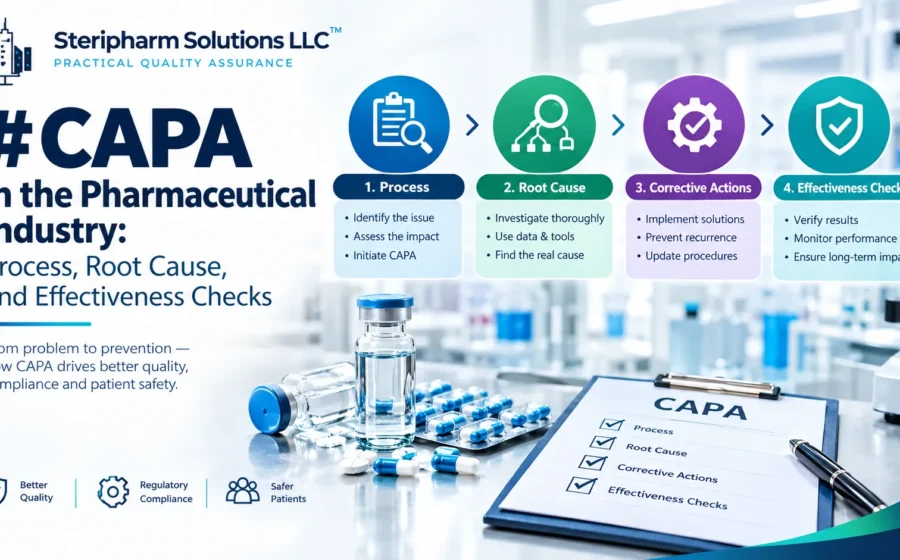
A pharmaceutical CAPA process identifies the root cause of a quality problem, implements corrective and preventive actions, verifies effectiveness, and documents closure within the quality system. It’s one of the most frequently cited weak points during FDA inspections — not because manufacturers lack a CAPA procedure, but because individual CAPAs are closed without genuine root-cause analysis or effectiveness verification.
This guide walks through the full CAPA lifecycle, what separates an effective CAPA from a documentation exercise, and the specific failure modes that lead to repeat findings. You’ll also find direct answers to the questions QA managers and compliance teams ask most about the CAPA process in pharmaceutical industry settings.
What Is CAPA in Pharma?
CAPA stands for Corrective and Preventive Action — a structured process that identifies the root cause of a quality problem, corrects the immediate issue, prevents recurrence, and verifies the fix actually worked before formally closing the record. CAPA is triggered by a range of quality events: deviations, out-of-specification results, complaints, audit findings, or trends identified through routine monitoring.
Definition box: CAPA (Corrective and Preventive Action) = the documented process linking a root-cause investigation to specific corrective actions (fixing the immediate problem), preventive actions (stopping recurrence), and an effectiveness check confirming the fix worked over time.
ICH Q9 frames CAPA as a core risk management tool within the pharmaceutical quality system, explicitly tying the depth of investigation and action to the risk level of the underlying issue {external_source: ICH Q9}. FDA’s CGMP Q&A guidance similarly treats CAPA as a required, ongoing system — not a one-time response to an isolated problem.
Takeaway: CAPA isn’t just about fixing what went wrong once — it’s a documented, risk-scaled loop that has to prove the fix actually prevents the problem from happening again.
What Are the Steps in the CAPA Process?
The CAPA process follows nine sequential steps: trigger identification, initial containment, root-cause investigation, corrective action planning, preventive action planning, implementation, effectiveness verification, documentation, and closure. Skipping or rushing any single step — particularly root cause and effectiveness verification — is the most common reason a CAPA fails to prevent recurrence.
The nine-step CAPA lifecycle
- Trigger identification — a deviation, OOS result, complaint, audit finding, or trend analysis flags a quality issue requiring formal investigation.
- Initial containment — immediate action to limit impact on product already in process or in the supply chain, taken before the full investigation is complete.
- Root-cause investigation — a structured analysis (5 Whys, fishbone diagram, fault tree analysis) to identify the true underlying cause, not just the immediate symptom.
- Corrective action planning — defining the specific action that fixes the immediate problem, with an owner and target date.
- Preventive action planning — defining broader changes that prevent the same root cause from producing a similar failure elsewhere in the system.
- Implementation — executing the corrective and preventive actions as planned, with documented evidence of each step.
- Effectiveness verification — confirming, after a defined monitoring period, that the root cause hasn’t recurred and the action actually worked.
- Documentation — a complete, traceable record linking the trigger, investigation, actions, and verification data together.
- Closure — formal sign-off, typically by QA, confirming all steps were completed and effectiveness was demonstrated.
Takeaway: A CAPA isn’t complete when the corrective action is implemented — it’s complete only after effectiveness verification confirms the root cause genuinely stopped recurring.
What Makes a CAPA Effective?
An effective CAPA is one where the corrective and preventive actions address a genuinely identified root cause, are implemented with clear ownership and realistic timelines, and are confirmed — through a defined effectiveness check — to have actually prevented recurrence over a monitored period. Effectiveness is proven with data, not assumed because the action was completed.
Characteristics of an effective CAPA
- Root cause, not symptom — the investigation identifies why the failure occurred, not just what happened during the event.
- Proportional depth — investigation and action scale with the risk and severity of the issue, following a risk-based approach.
- Specific, owned actions — each action has a named owner and a defined completion date, not a vague commitment to “review the process.”
- A real effectiveness check — a defined monitoring period and measurable criteria confirm the root cause hasn’t recurred, rather than simply documenting that the action was completed.
- Cross-referenced to related systems — a CAPA connects back to the originating deviation and, where relevant, triggers a change control record if a process or procedure is being modified.
Takeaway: The single clearest signal of an effective CAPA is a documented effectiveness check with real monitoring data — not just a checklist confirming the planned action was carried out.
Why Do CAPAs Fail?
CAPAs most commonly fail because the root-cause investigation stops at a surface-level explanation, the corrective action addresses a symptom rather than the underlying cause, or the CAPA is closed without a genuine effectiveness check. Repeat deviations tied to a previously “closed” CAPA are one of the clearest signals FDA investigators look for during an inspection.
Common CAPA failure modes
| Failure Mode | What It Looks Like | Consequence |
|---|---|---|
| Symptom-level root cause | “Human error” listed with no deeper investigation | Same deviation recurs under similar conditions |
| Generic corrective action | “Retrain staff” with no specific procedural change | Training completed, but underlying process gap remains |
| No effectiveness check | CAPA closed immediately after action is implemented | No data confirms the fix actually worked |
| Missed link to change control | Process change made without formal change control approval | Investigator flags an uncontrolled, unapproved change |
| Copy-paste investigations across similar CAPAs | Same root-cause language reused for different events | Investigation looks templated rather than event-specific |
| Overdue or extended-without-justification CAPAs | Target dates repeatedly pushed with no documented reason | Signals systemic resourcing or prioritization problems |
Takeaway: Nearly every CAPA failure mode traces back to one of two root problems — investigation stopped too early, or closure happened before the fix was actually proven to work.
How Do Deviations, CAPA, and Change Control Connect?
CAPA sits at the center of a feedback loop between deviations and change control: a deviation triggers the CAPA investigation, and if the resulting preventive action requires a process, equipment, or documentation change, that change must go through formal change control before implementation. Skipping change control to implement a CAPA-driven fix quickly is a common and serious inspection finding.
This connection matters because it prevents a well-intentioned fix from becoming its own compliance problem. A preventive action that modifies a validated process, for example, needs risk assessment and formal approval through change control — implementing it directly through the CAPA record alone bypasses the very system designed to control that kind of change.
Takeaway: A CAPA that changes how something is done isn’t finished when the fix works — it’s finished when that fix has also been properly captured and approved through change control.
Frequently Asked Questions
CAPAs most commonly fail when root-cause investigation stops at a surface-level explanation, the corrective action treats a symptom rather than the cause, or the CAPA is closed without a genuine effectiveness check. Repeat deviations linked to a “closed” CAPA are one of the clearest signals FDA investigators look for.
The monitoring period should be proportional to the risk and frequency of the underlying issue — a high-frequency process might need only a few production cycles, while a rare or high-severity issue may require monitoring across several months. The key requirement is that the period be long enough to reasonably confirm the root cause hasn’t recurred, not a fixed universal timeframe.
Common methods include the 5 Whys, fishbone (Ishikawa) diagrams, and fault tree analysis, often selected based on the complexity of the issue. Simple, isolated deviations may only need a 5 Whys analysis, while systemic or recurring issues typically warrant a more structured method like fault tree analysis.
No — closing a CAPA before effectiveness is verified defeats the purpose of the process, since there’s no data confirming the fix actually worked. FDA investigators specifically look for CAPAs closed immediately after implementation with no monitoring period, which is a common and serious finding.
Not necessarily — many quality systems scale the investigation and action depth to the risk level of the deviation, reserving full CAPA treatment for issues with genuine quality or safety impact. Minor, well-understood deviations may be addressed through a lighter documented process, provided the system defines clear criteria for that distinction.
A corrective action fixes the specific instance of the problem that already occurred, while a preventive action addresses the broader root cause to stop the same type of failure from happening elsewhere in the system. A CAPA that only includes corrective action without a preventive component is generally considered incomplete.
Aggregated CAPA data — recurring root causes, overdue items, effectiveness trends — is typically reviewed during periodic management review, giving leadership visibility into systemic quality issues beyond any single event. This connection is part of why FDA looks for evidence that management review actually acts on CAPA trend data, not just individual case closures.
Conclusion
A CAPA process is only as strong as its weakest step, and in practice, that weak step is almost always root-cause depth or effectiveness verification — the two places where documentation can look complete without the underlying problem actually being solved. Manufacturers who treat effectiveness checks as non-negotiable, and who consistently link CAPA to change control where needed, see far fewer repeat findings during FDA inspections.
Steripharm Solutions LLC, led by Pramod Sharma, Ph.D., helps sterile injectable, ophthalmic/otic, oral dosage, and transdermal manufacturers across the Americas, Europe, and India strengthen CAPA programs — from root-cause methodology through effectiveness verification — as part of a fully integrated quality management system.
Talk to our QA/compliance team → Steripharm Quality Assurance Services