A pharmaceutical vendor audit is a risk-based assessment of a supplier, CMO, laboratory, or service provider against applicable quality and CGMP expectations — and FDA holds the manufacturer, not the vendor, ultimately responsible when a supplier’s quality failure affects a finished product. That responsibility is exactly why vendor audits can’t be treated as a one-time checkbox during onboarding.
This guide walks through how to plan and conduct a pharmaceutical vendor audit — from risk-based selection through ongoing monitoring — and what FDA and CGMP expectations actually require at each stage. You’ll also find direct answers to the questions QA, procurement, and CMO management teams ask most about vendor audits in the pharmaceutical industry.
What Is a Pharmaceutical Vendor Audit?
A pharmaceutical vendor audit is a structured, risk-based assessment of a supplier, contract manufacturer (CMO), testing laboratory, or service provider’s quality systems and CGMP compliance, conducted before qualification and periodically afterward. It exists because FDA’s CGMP framework requires manufacturers to ensure that any component, service, or process performed by an outside party meets the same quality standards as their own operations.
Definition box: Pharmaceutical vendor audit = an on-site or remote assessment evaluating a supplier’s quality management system, facility conditions, and CGMP compliance against the specific role that vendor plays in a manufacturer’s supply chain.
FDA’s CGMP Q&A guidance and ICH Q9 both frame vendor oversight as a risk management responsibility that sits with the manufacturer, not something that transfers to the vendor once a contract is signed {external_source: FDA CGMP Q&A; ICH Q9}. In practice, this means the depth and frequency of vendor audits should scale with the vendor’s impact on final product quality and patient safety.
Takeaway: A vendor audit exists because FDA holds the manufacturer accountable for a supplier’s CGMP failures — outsourcing a process doesn’t outsource the compliance responsibility.
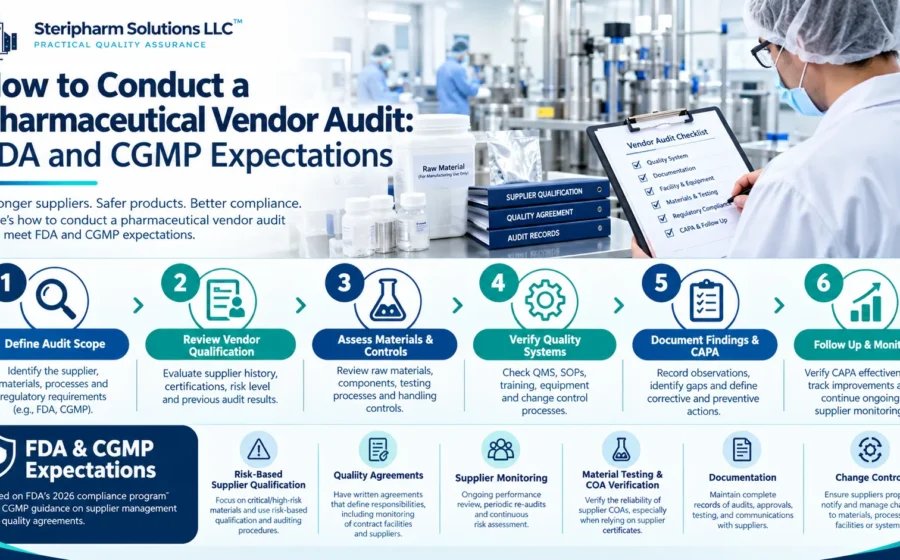
How to Conduct a Pharmaceutical Vendor Audit: Step by Step
Step 1: Risk-based supplier categorization
Before scheduling any audit, categorize vendors by risk — a raw material supplier for a critical excipient in a sterile injectable carries far more risk than a vendor supplying secondary packaging materials. This categorization drives audit depth, frequency, and whether an on-site visit is warranted versus a documentation-based review.
Step 2: Pre-audit preparation
Request the vendor’s quality manual, relevant certifications, recent regulatory inspection history, and any prior audit reports from other customers. Define a clear audit scope and checklist in advance, tailored to the specific role the vendor plays — a CMO performing full manufacturing requires a far broader scope than a calibration service provider.
Step 3: Document review
Review the vendor’s SOPs, quality agreements, deviation and CAPA history, training records, and — for CMOs and testing labs — recent batch records or Certificates of Analysis. This review should happen before the on-site portion of the audit so findings can be probed directly during facility observation and personnel interviews.
Step 4: On-site (or remote) audit execution
Conduct facility walkthroughs, personnel interviews, and live record review against the pre-defined checklist, documenting observations as they’re identified rather than reconstructing them afterward from memory. For remote audits, request live video walkthroughs and real-time document access rather than relying solely on pre-submitted materials.
Step 5: Findings and gap classification
Classify findings by severity — typically critical, major, and minor — based on potential impact to product quality and patient safety, following a structure similar to how FDA classifies inspection observations. Critical findings should trigger an immediate discussion with the vendor before the audit even concludes.
Step 6: CAPA and remediation tracking
Require the vendor to submit a formal CAPA plan for any findings, with root cause, corrective action, and timelines, and track that plan to closure the same way an internal CAPA would be tracked. A vendor audit that generates findings but no tracked remediation plan provides little real risk reduction.
Step 7: Qualification decision
Based on audit results and CAPA commitments, make a formal qualification decision — approved, conditionally approved pending remediation, or rejected — and document that decision along with the supporting rationale. This decision should be reviewed and approved by QA, not procurement alone.
Step 8: Ongoing monitoring
Qualification isn’t permanent — schedule periodic re-audits based on risk category, and monitor the vendor continuously through incoming material testing trends, complaint data, and any regulatory actions issued against the vendor between formal audits.
[Internal Link: talk to our quality assurance team about supplier programs → /quality-assurance/]
Takeaway: A vendor audit is a full lifecycle — risk categorization, document review, on-site execution, CAPA tracking, and ongoing monitoring — not a single site visit that ends with a pass/fail stamp.
What Should a Vendor Audit Include?
A complete vendor audit should include a documented risk assessment justifying audit scope and frequency, a pre-defined checklist tailored to the vendor’s role, document and record review, facility observation, personnel interviews, a written findings report with severity classification, and a tracked CAPA plan for any gaps identified.
Core elements of a thorough vendor audit
- Quality management system review — document control, deviation handling, CAPA process, and change control at the vendor.
- Facility and equipment observation — cleanliness, maintenance, calibration status, and environmental controls relevant to the vendor’s role.
- Personnel qualification — training records and role-specific competency for staff performing CGMP-relevant activities.
- Batch or lot traceability — for CMOs and material suppliers, the ability to trace a specific batch through the vendor’s own records.
- Regulatory history — any prior FDA (or equivalent international) inspection findings, warning letters, or import alerts affecting the vendor.
- Quality agreement alignment — confirmation that actual practices match the responsibilities defined in the quality agreement between the two companies.
Takeaway: A vendor audit that only reviews documents misses the point — the strongest audits cross-check what the vendor’s records claim against what facility observation and personnel interviews actually reveal.
How Often Should Pharma Suppliers Be Audited?
Pharma suppliers should be audited at a frequency proportional to their risk category — typically annually for high-risk vendors like CMOs and critical raw material suppliers, every two to three years for moderate-risk vendors, and less frequently (or via documentation-based review) for low-risk service providers. Frequency should also increase immediately following any significant finding, quality event, or regulatory action involving the vendor.
| Vendor Risk Category | Example | Typical Audit Frequency |
|---|---|---|
| High risk | CMO performing full manufacturing, critical API/excipient supplier | Annually, on-site |
| Moderate risk | Component supplier, testing laboratory | Every 2–3 years |
| Low risk | Calibration services, non-critical packaging materials | Documentation review, or 3–5 year cycle |
Takeaway: Audit frequency should track risk, not a fixed calendar — a high-risk CMO and a low-risk packaging supplier shouldn’t be on the same audit cycle.
What Documents Should Be Reviewed During a Vendor Audit?
Documents to review during a vendor audit include the vendor’s quality manual, relevant SOPs, deviation and CAPA logs, training and qualification records, equipment calibration and maintenance logs, batch records or Certificates of Analysis where applicable, prior audit reports, and evidence of the vendor’s own supplier qualification program if they in turn use subcontractors.
Reviewing prior audit reports from other customers, where available, can also surface issues a manufacturer’s own audit team might not think to probe. For CMOs specifically, reviewing a sample of actual executed batch records — not just the template SOPs — often reveals gaps between documented procedure and real practice that a document-only review would miss.
Takeaway: The most revealing document review compares what a vendor’s SOPs say should happen against what their actual executed batch records and deviation logs show did happen.
Frequently Asked Questions
A pharmaceutical vendor audit is a risk-based assessment of a supplier, CMO, laboratory, or service provider’s quality systems and CGMP compliance, conducted before qualification and periodically afterward. It exists because FDA holds the manufacturer accountable for a vendor’s quality failures, regardless of the outsourcing arrangement.
A complete audit includes a documented risk assessment, a tailored checklist, document and record review, facility observation, personnel interviews, a severity-classified findings report, and a tracked CAPA plan for any gaps. The strongest audits cross-check vendor documentation against actual facility practice.
Audit frequency should scale with risk — typically annually for high-risk vendors like CMOs, every two to three years for moderate-risk suppliers, and less frequently for low-risk service providers. Frequency should increase immediately after any significant finding or regulatory action involving the vendor.
Key documents include the quality manual, relevant SOPs, deviation and CAPA logs, training records, calibration and maintenance logs, batch records or Certificates of Analysis, and prior audit reports. For CMOs, reviewing actual executed batch records — not just template procedures — often reveals the most meaningful gaps.
The manufacturer bears ultimate FDA accountability for CGMP failures affecting a finished product, even when the failure originates with a vendor or CMO. This is why vendor qualification and ongoing audit programs are treated as a manufacturer’s own compliance responsibility, not an optional courtesy check.
Vendor qualification is the overall decision-making process that determines whether a supplier is approved to provide materials or services, while a vendor audit is one specific activity within that process, providing the on-site or documented evidence supporting the qualification decision. Qualification typically also includes quality agreements, sample testing, and risk categorization alongside the audit itself.
A remote audit can be effective, particularly for lower-risk vendors, but it should still include live video facility walkthroughs and real-time document access rather than relying only on pre-submitted materials. For high-risk vendors like CMOs, an on-site audit generally remains the stronger standard, especially for initial qualification.
A critical finding should be discussed with the vendor immediately, often before the audit even concludes, and typically requires a formal CAPA plan with defined timelines before qualification can proceed or continue. Depending on severity, a critical finding may also trigger a hold on incoming materials or services from that vendor until remediation is verified.
Yes, if the audit reveals a mismatch between what the quality agreement specifies and what the vendor actually practices, the agreement should be updated to reflect accurate, enforceable responsibilities. A quality agreement that doesn’t match real practice provides little protection during an FDA inspection tracing accountability between the two companies.
Findings from a vendor audit that could affect product quality should feed into the manufacturer’s own deviation and CAPA system, not remain isolated in a separate vendor management file. This connection ensures that a supplier-driven quality issue is evaluated with the same rigor as an internal one, including root-cause analysis and effectiveness verification.
Conclusion
A pharmaceutical vendor audit is only as strong as the risk-based thinking behind it — matching audit depth and frequency to actual impact on product quality, cross-checking documentation against real practice, and tracking findings to genuine closure rather than a one-time pass. Manufacturers who treat vendor oversight as a continuous program, not an onboarding formality, are the ones best positioned when FDA traces a quality issue back through the supply chain.
Steripharm Solutions LLC, led by Pramod Sharma, Ph.D., helps sterile injectable, ophthalmic/otic, oral dosage, and transdermal manufacturers across the Americas, Europe, and India build risk-based vendor audit and CMO due diligence programs that hold up under FDA scrutiny.
Get vendor audit and due diligence support → Steripharm FDA Compliance Services