Every drug manufacturer operating in the United States answers to the same regulatory authority, but no two quality systems look exactly alike. Facility size, product type, manufacturing complexity, and inspection history all shape how much regulatory risk a company is carrying at any given time. That’s where FDA compliance consulting comes in — bringing outside expertise to interpret requirements, strengthen quality systems, and prepare for the moment an FDA investigator walks through the door.
This guide breaks down what FDA compliance consulting actually involves, when manufacturers typically bring in outside help, what services are usually included, and how to evaluate a consulting partner.
What Is FDA Compliance Consulting?
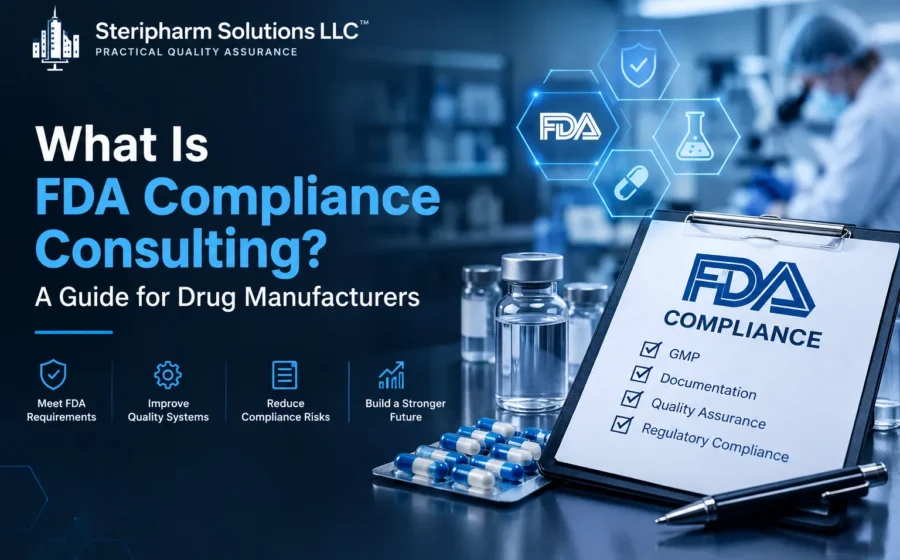
FDA compliance consulting is specialized advisory support that helps drug manufacturers understand, implement, and maintain compliance with FDA regulations — most notably Current Good Manufacturing Practice (CGMP) requirements under 21 CFR Parts 210 and 211. Consultants work alongside internal quality, regulatory, and operations teams to translate dense regulatory language into practical systems, procedures, and behaviors on the manufacturing floor.
Unlike a one-time audit, compliance consulting is typically an ongoing or project-based relationship. It can range from a focused gap assessment ahead of a planned inspection to a multi-year remediation engagement following a Warning Letter. The common thread is that the consultant functions as an extension of the quality team — bringing pattern recognition from across the industry that an internal team, however capable, usually doesn’t have on its own.
What Does an FDA Compliance Consultant Do?
The scope of work varies by engagement, but most FDA compliance consulting relationships touch some combination of the following areas:
- Quality system evaluation. Reviewing how well existing systems align with CGMP expectations and frameworks like ICH Q10, which describes a pharmaceutical quality system spanning the full product lifecycle.
- Gap analysis. Comparing current procedures, documentation, and practices against regulatory requirements to identify weak points before FDA does.
- Inspection readiness. Preparing facilities and personnel for FDA inspections, including mock inspections, interview coaching, and document-room organization.
- Response drafting and remediation. Helping companies respond to a Form 483 observation or Warning Letter, and building out the corrective and preventive action (CAPA) plans that follow.
- Standard operating procedure (SOP) development. Writing or revising SOPs so they reflect both regulatory requirements and how work actually happens on site.
- Training and change management. Supporting staff through new procedures so compliance improvements actually stick after the consultant leaves.
Not every engagement includes all of these. A company preparing for its first inspection needs a very different scope of work than one working through a Warning Letter remediation timeline.
When Should a Pharma Company Hire a Compliance Consultant?
There’s no single trigger point, but a few scenarios come up consistently:
Before a planned or anticipated FDA inspection. Companies often bring in a consultant several months ahead of an expected inspection to run a mock audit and close gaps while there’s still time.
After receiving a Form 483 or Warning Letter. Once FDA has issued findings, the clock is running. Consultants help draft timely, credible responses and build remediation plans that hold up to follow-up scrutiny.
During facility expansion or new product launches. New manufacturing lines, new dosage forms, or new facilities all introduce compliance risk that’s easier to manage with experienced outside input from the start.
When internal quality resources are stretched thin. Smaller and mid-sized manufacturers, in particular, often don’t have the bandwidth or specialized depth to handle a major compliance initiative alongside day-to-day quality operations.
Following a merger, acquisition, or leadership change. Combining quality systems or bringing in new compliance leadership is a natural point to bring in a consultant to baseline where things actually stand.
How Much Does FDA Compliance Consulting Involve?
The scope and duration of a consulting engagement depends heavily on the starting point. A narrow gap assessment might run a few weeks and focus on a single quality system, such as deviation management or documentation practices. A full remediation program tied to a Warning Letter can extend over a year or more and touch nearly every part of the quality system, often with periodic FDA check-ins along the way.
Most engagements move through a similar arc regardless of size:
- Assessment — understanding the current state of the quality system against regulatory expectations.
- Planning — prioritizing gaps by risk and building a realistic remediation timeline.
- Implementation — updating procedures, systems, and training.
- Verification — confirming that changes are effective and sustainable, not just documented.
Manufacturers should expect a consulting partner to be transparent about scope early on, rather than presenting a vague or open-ended engagement.
Benefits and Limitations of FDA Compliance Consulting
Benefits:
- Access to specialized regulatory and technical expertise without a full-time hire
- An outside perspective that can spot blind spots internal teams have grown used to
- Faster, more structured response to inspection findings
- Reduced risk of repeat observations across inspection cycles
Limitations:
- Consultants can advise and build systems, but compliance ownership ultimately stays with the manufacturer
- Outside expertise doesn’t replace the need for internal quality culture and accountability
- Poorly scoped engagements can produce documentation that looks compliant without changing actual practices on the floor
The most effective engagements treat consulting as a way to build internal capability, not as a substitute for it.
How to Choose an FDA Compliance Consulting Partner
A few questions are worth asking before signing on with any pharmaceutical consulting firm:
- Do they have direct experience with your product type and manufacturing process?
- Can they point to relevant experience with FDA inspections, Form 483 responses, or Warning Letter remediation?
- Will the same consultants who scope the project actually do the work?
- Do they build systems your team can sustain, or do they leave once the engagement ends?
A consulting relationship that only produces documents — without transferring understanding to the internal team — tends to leave companies exposed again at the next inspection cycle.
FAQ
FDA compliance consulting is advisory support that helps drug manufacturers meet FDA regulatory requirements, particularly CGMP standards under 21 CFR Parts 210 and 211, through gap analysis, system improvements, and inspection preparation.
A consultant evaluates quality systems, identifies compliance gaps, helps prepare for inspections, supports responses to FDA findings like Form 483 observations or Warning Letters, and helps build sustainable CAPA and remediation plans.
Common triggers include an upcoming inspection, a recent Form 483 or Warning Letter, facility expansion, new product launches, or internal quality teams that are stretched beyond their capacity.
Scope varies widely — from a short, focused gap assessment lasting a few weeks to a multi-year remediation program following serious FDA findings. Most engagements follow an assessment, planning, implementation, and verification arc.
If your team is weighing whether a compliance gap needs outside support, it’s worth discussing your specific objective with a consultant before it becomes an inspection finding. You can also learn more about our full range of regulatory and quality services or read our related guide on what CGMP compliance actually requires.