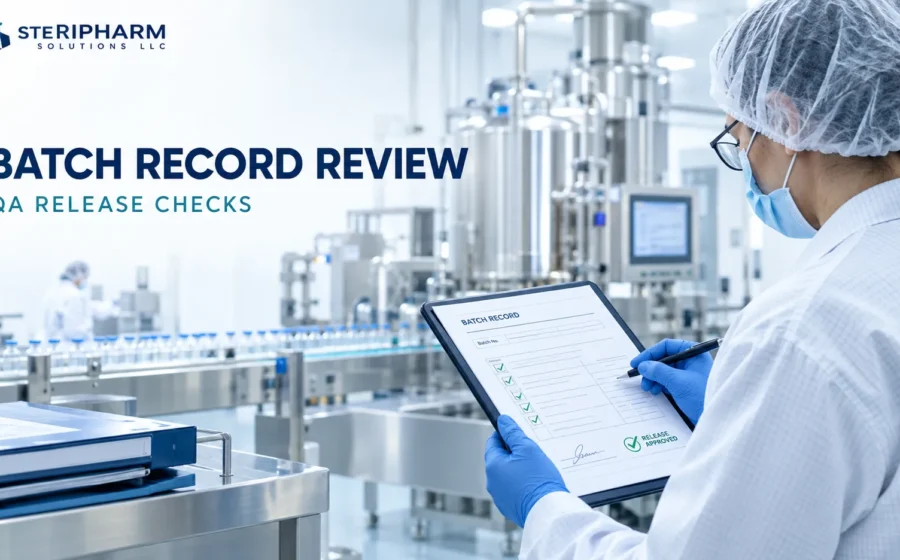
Batch record review is a documented quality review used to verify that manufacturing and testing activities were performed according to approved procedures and that required records are complete and traceable. It’s the last structured checkpoint before a batch reaches patients, which is why FDA treats an incomplete or inconsistent batch record as one of the clearest signals a quality system isn’t functioning as designed.
This guide explains the review logic QA teams apply to a batch record, what’s checked at each stage, and the deficiencies that most often trigger further investigation before release. It focuses on the principles behind a thorough review rather than facility-specific instructions, since batch record structure and specific checks vary by product and process. You’ll also find direct answers to the questions batch release teams ask most about batch record review.
What Is Batch Record Review?
Batch record review is the documented, systematic QA process of examining a completed Batch Manufacturing Record (BMR) or Batch Production Record (BPR) to confirm that every manufacturing and testing step was performed, documented, and verified according to approved procedures before a batch can be released. Under 21 CFR Part 211, this review is a required part of batch disposition, not an optional quality check {external_source: FDA 21 CFR Part 211}.
Definition box: Batch record review = the QA-led verification that a completed batch record is accurate, complete, and traceable — confirming that what the approved procedure required actually happened, was documented as it happened, and was checked by a second, independent reviewer.
FDA’s CGMP Q&A guidance reinforces that this review has to be more than a signature check — reviewers are expected to actively compare recorded data against specifications and to identify inconsistencies, not simply confirm that every field on the form was filled in.
Takeaway: Batch record review exists to answer one question with documented evidence — did this specific batch follow the approved process exactly, and can that be proven from the record alone?
What Does QA Check in a Batch Record?
QA reviews a batch record for completeness, accuracy, and consistency across seven core areas: record completeness, critical process parameter entries, deviation documentation, material reconciliation, signatures and timestamps, in-process and release test results, and overall traceability of the batch from start to finish. Each area is checked not in isolation, but for whether it’s internally consistent with the others.
The seven core review areas
- Record completeness — every required field, signature, and attachment specified by the approved batch record template is present, with no blank or skipped entries.
- Critical process parameter entries — recorded values for temperature, time, mixing speed, pressure, or other critical parameters fall within the validated ranges defined in the approved process.
- Deviation documentation — any deviation noted during production is properly referenced, investigated, and — where required — resolved or formally linked to an open investigation before release.
- Material reconciliation — quantities of raw materials issued, used, and accounted for (including any rejected or discarded material) balance against expected yield calculations.
- Signatures and timestamps — every entry is signed and dated by the person who performed the activity, in the correct sequence, with no gaps or out-of-order timestamps.
- In-process and release test results — QC test results referenced in the batch record match the actual Certificate of Analysis and fall within specification.
- Overall traceability — the record allows a reviewer to reconstruct the batch’s full history end to end, from raw material receipt through final packaging, without unexplained gaps.
Takeaway: A batch record review isn’t seven separate checklists — it’s one integrated review looking for whether the record tells a single, consistent, traceable story from start to finish.
What Are Common Batch Record Errors?
Common batch record errors include missing or out-of-sequence signatures, unexplained blank fields, material reconciliation discrepancies, recorded values outside validated critical parameter ranges, and deviations referenced in the record but not properly linked to a formal investigation. Most of these errors are procedural or documentation gaps rather than actual process failures — but they still have to be resolved before release, since the record itself has to demonstrate compliance.
Frequently seen deficiencies
- Blank or “N/A” fields with no explanation — a field left blank without documented justification raises the question of whether the step was actually performed.
- Late entries or corrections without proper annotation — CGMP documentation requires contemporaneous recording; corrections need to follow a defined process (single-line strikethrough, initials, date, reason) rather than being erased or overwritten.
- Reconciliation discrepancies — unexplained gaps between materials issued and materials accounted for at the end of the batch.
- Deviation references without a linked investigation number — a note in the record referencing “see deviation” with no traceable investigation record attached.
- Mismatched or missing second-person verification — critical steps requiring independent double-checks (weighing, calculation, dispensing) missing the second reviewer’s signature.
Takeaway: Most batch record deficiencies are documentation gaps, not process failures — but an incomplete record can’t distinguish between the two, which is exactly why the review has to be thorough before release.
When Should a Batch Be Rejected or Investigated?
A batch should be flagged for further investigation — and release should be held — whenever a critical process parameter falls outside its validated range, an unresolved or unexplained deviation exists, material reconciliation doesn’t balance within acceptable limits, or a test result is out of specification, regardless of how minor any single discrepancy might appear. QA’s role at this stage is to determine whether the issue affects the specific batch, a broader trend, or both.
Decision framework for release, hold, or reject
| Situation | Typical QA Action |
|---|---|
| Minor documentation gap, fully explainable and correctable | Correct per documented procedure, review, proceed if no quality impact |
| Critical parameter outside validated range | Hold batch, open formal deviation and investigation |
| Unresolved or unlinked deviation reference | Hold batch until investigation is completed and reviewed |
| Material reconciliation discrepancy beyond limits | Hold batch, investigate for potential yield or process issue |
| Out-of-specification test result | Hold batch, initiate OOS investigation per QC/QA procedure |
A batch is never released with an open, unresolved quality question — the review process exists specifically to force that decision to be made deliberately, with documentation, rather than by default.
Takeaway: The threshold for holding a batch isn’t the severity of the issue on its face — it’s whether the record can fully explain and resolve the discrepancy before disposition.
How Does the Batch Record Review Workflow Typically Proceed?
The batch record review workflow typically moves through three stages: an initial production-area or first-level review confirming completeness at the point of execution, a QA second-level review evaluating compliance and consistency against the full record, and a final batch disposition decision made by QA based on the complete, reviewed record alongside all associated QC results. Each stage is documented and traceable to a specific reviewer.
This layered structure exists so that a single reviewer isn’t solely responsible for catching every possible gap — the production-level review catches obvious completeness issues close to when they occur, while the QA-level review applies a broader, independent lens across the entire record and its connections to deviations, CAPA, and QC data.
Takeaway: Batch record review works best as a layered process — a close, real-time completeness check followed by an independent QA review — rather than a single reviewer trying to catch everything at once.
Frequently Asked Questions
Batch record review is the documented QA process of examining a completed batch record to confirm manufacturing and testing activities were performed and documented according to approved procedures. It’s a required part of batch disposition under 21 CFR Part 211, not an optional quality check.
QA checks record completeness, critical process parameter entries, deviation documentation, material reconciliation, signatures and timestamps, test result consistency, and overall traceability from start to finish. These areas are reviewed together, looking for internal consistency across the whole record rather than as separate checklists.
Common errors include unexplained blank fields, late or improperly annotated corrections, material reconciliation discrepancies, deviations referenced without a linked investigation, and missing second-person verification on critical steps. Most are documentation gaps rather than actual process failures, but they still require resolution before release.
A batch should be held for investigation whenever a critical process parameter falls outside its validated range, an unresolved deviation exists, material reconciliation doesn’t balance, or a test result is out of specification. A batch should never be released with an open, unexplained quality question.
Batch record review should be performed by trained personnel independent of the activity being reviewed, typically starting with a production-area first-level review followed by an independent QA second-level review. The QA reviewer specifically needs authority separate from production to make an objective disposition decision.
Review time varies significantly with batch complexity and record length, ranging from same-day review for simple, error-free records to several days when deviations or discrepancies require additional investigation before disposition can proceed. Manufacturers should track review cycle time as a metric, since chronically slow reviews can signal an under-resourced QA function.
A first-level review, typically done in the production area, checks for completeness and obvious errors close to when the activity occurred, while a second-level QA review independently evaluates the full record for compliance, consistency, and any connections to deviations or CAPA. The second-level review is what ultimately supports the batch disposition decision.
Yes, but corrections must follow a defined, documented process — typically a single-line strikethrough, initials, date, and a stated reason — rather than erasing or overwriting the original entry. Undocumented or improperly annotated corrections are a common finding during FDA inspections, since they undermine the record’s reliability as a contemporaneous account.
Material reconciliation is the check confirming that the quantities of raw materials issued, used, and accounted for — including any rejected or discarded material — balance against expected yield calculations for that batch. An unexplained discrepancy can indicate a documentation error, a process issue, or, in rare cases, a more serious control gap that requires investigation.
Not automatically — deviation severity and its specific impact on the batch determine whether release can proceed, but every deviation must be properly referenced, investigated, and resolved (or the investigation formally completed) before QA can make a disposition decision. A batch is never released with a deviation left open or unaddressed in the record.
Conclusion
Batch record review works because it forces a deliberate, documented answer to a simple question for every single batch: does the record prove this product was made exactly as the approved process required? The manufacturers with the fewest release delays and inspection findings are the ones whose review process catches gaps at the production level, before they ever reach the QA disposition decision.
Steripharm Solutions LLC, led by Pramod Sharma, Ph.D., helps sterile injectable, ophthalmic/otic, oral dosage, and transdermal manufacturers across the Americas, Europe, and India strengthen batch record review processes and reduce recurring documentation deficiencies before they affect release timelines.
Get batch record review support → Steripharm Quality Assurance Services