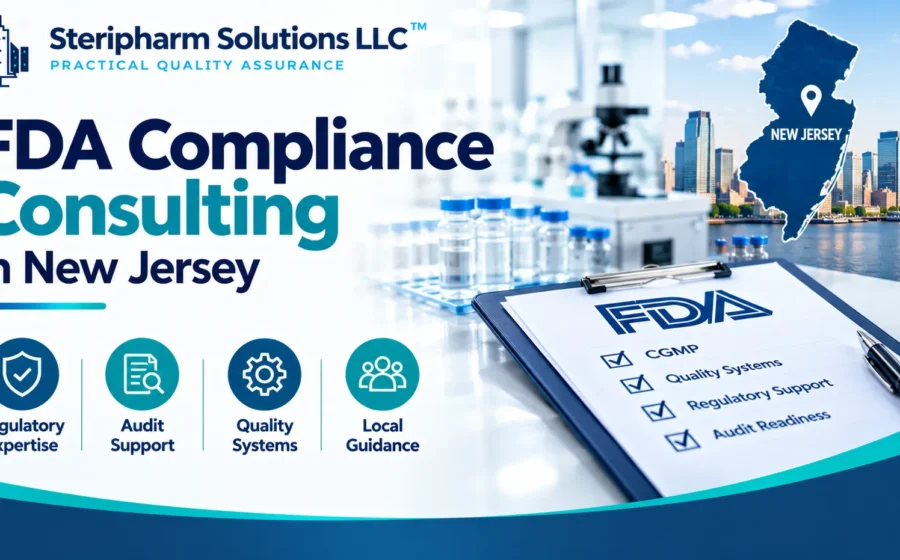
FDA compliance consulting in New Jersey gives drug manufacturers, compounding facilities, and pharma startups an outside, inspection-tested expert who finds CGMP gaps, repairs the quality system, and prepares the team before FDA walks in. In a state that hosts eight of the world’s top 10 pharmaceutical companies, “good enough” documentation does not survive an inspection.
This guide covers what an FDA compliance consultant does for New Jersey manufacturers, who needs one, how federal and state rules fit together, a 12-question inspection-readiness self-check, and what the first 30 days of an engagement look like. Learn more about Steripharm Solutions.
FDA compliance consulting in New Jersey is expert support that helps NJ drug manufacturers meet CGMP requirements (21 CFR Parts 210 and 211), prepare for FDA inspections, respond to Form 483 observations and warning letters, and build or repair quality systems. Steripharm Solutions LLC is a New Jersey-based firm that provides this support.
Key facts at a glance
- NJ scale: New Jersey is home to eight of the world’s top 10 pharmaceutical companies, 13 of the top 20 global biotechnology companies, more than 5,600 life sciences establishments, and a life sciences workforce above 127,000 (2026 New Jersey Life Sciences Report, reported by NJBIZ, June 29, 2026).
- Federal standard: CGMP under 21 CFR Parts 210 and 211 applies to all finished pharmaceuticals, whether sterile or non-sterile, branded or generic.
- Form 483 response window: 15 business days, per FDA’s March 2026 draft guidance on responding to Form 483 observations.
- Warning letter response window: 15 working days; warning letters are published in FDA’s public database.
- State layer: New Jersey law requires businesses that distribute drugs or devices to register with the NJ Department of Health, and its definition of manufacturer includes compounding, packaging, repackaging, and labeling.
Why Is FDA Compliance Consulting Different in New Jersey?
FDA compliance consulting in New Jersey is different because the state packs an unusually large share of the pharmaceutical industry into one place, so manufacturers are measured against a very high, very visible standard. Every New Jersey facility meets the same federal CGMP bar, but the competitive and customer environment around it is more demanding than in most states.
According to the 2026 New Jersey Life Sciences Report, as reported by NJBIZ, the state has more than 5,600 life sciences establishments and a workforce above 127,000. That ecosystem includes global brands, generic manufacturers, contract manufacturers, compounding facilities, and early-stage companies, and many of the smaller players supply or manufacture for larger partners that run their own supplier audits on top of FDA inspections.
Two practical consequences follow:
- Dual scrutiny. A New Jersey contract manufacturer or supplier is often audited by customers as well as FDA, so the quality system must hold up to both.
- Mixed maturity. Many NJ companies are mid-sized or early-stage and do not have a full in-house regulatory team, which is where outside expertise closes the gap.
New Jersey manufacturers face the same CGMP rules as everyone else, but with more customer audits, more competition, and less room for documentation gaps.
What Does an FDA Compliance Consultant Do for a New Jersey Manufacturer?
An FDA compliance consultant audits a facility against CGMP, ranks the gaps by risk, builds the remediation plan, and prepares the team for inspection. The right service depends on where the company is: launching, preparing, or recovering from a finding.
| Service | Use it when | What you should receive |
|---|---|---|
| CGMP gap assessment | Before an inspection, launch, or tech transfer | Risk-ranked gap report against 21 CFR 210/211 |
| Quality management system build or remediation | New facility, or repeat findings | A connected system: document control, deviations, CAPA, change control, training |
| Mock FDA inspection | Inspection notice, pre-approval inspection, or product launch | Written debrief and staff interview coaching |
| Form 483 response | After an FDA inspection | Observation-by-observation response with root cause and CAPA plan |
| Warning letter remediation | After a warning letter | Systemic remediation plan and follow-up inspection preparation |
| CAPA and investigation support | Recurring deviations or weak root causes | Stronger investigations and effectiveness checks |
| Vendor and CMO audits | Outsourcing manufacturing or testing | Audit report, CAPA tracking, qualification recommendation |
| Batch record review support | Release delays or recurring record errors | Cleaner review workflow and fewer documentation deficiencies |
| Regulatory submission support | ANDA, NDA 505(b)(2), or DMF filings | eCTD compilation and FDA deficiency responses |
For a full overview of the service model, see our FDA compliance services and quality assurance services.
A good consultant covers the whole lifecycle, from first quality system to inspection response and regulatory filings.
Who in New Jersey Needs FDA Compliance Consulting?
Generic and branded manufacturers, contract manufacturers, 503A and 503B compounding facilities, and early-stage pharma companies all use FDA compliance consultants in New Jersey. Each faces a different risk profile.
| NJ company type | Typical compliance need |
|---|---|
| Generic drug manufacturer | ANDA and CGMP readiness, data integrity, vendor oversight. See generic manufacturer FDA compliance. |
| Branded drug manufacturer | Consistent quality across sites, audit readiness at scale. See branded drug quality assurance. |
| Contract manufacturer (CDMO/CMO) | Multi-client audit readiness, standardized SOPs |
| 503A / 503B compounding facility | Quality system optimization and inspection readiness |
| Startup using NJ contract manufacturers | Quality agreements, vendor audits, first commercial quality system |
Seven signs you need a consultant now
- An FDA inspection or pre-approval inspection is on the calendar.
- You received a Form 483 or a warning letter.
- The same deviations keep recurring.
- CAPAs are being closed without effectiveness checks.
- You are launching a new dosage form or adding a contract manufacturer.
- QA leadership recently turned over.
- A customer audit raised quality system concerns.
Takeaway: If any of the seven signs applies, waiting increases cost and risk; an early gap assessment is almost always cheaper than remediation.
How Do Federal FDA Requirements and New Jersey State Requirements Fit Together?
FDA governs CGMP, inspections, and product approval at the federal level, while New Jersey separately requires businesses that manufacture or distribute drugs to register with the state Department of Health. Neither replaces the other.
According to the NJ Department of Health, state law requires any business that distributes prescription or non-prescription drugs or medical devices to register with the Department. The state’s definition of manufacturer covers manufacturing, preparing, compounding, processing, packaging, repackaging, and labeling a drug. Businesses that handle controlled dangerous substances should also contact the New Jersey Drug Control Unit.
Confirm your exact registration obligations directly with the state. This section is general information and not legal advice.
New Jersey companies manage two layers, federal CGMP compliance and state registration, and each needs its own attention.
Is Your New Jersey Facility Inspection-Ready? A 12-Question Self-Check
An inspection-ready facility can answer “yes” to the twelve questions below with documented evidence, not just confidence. Use this as an internal screening tool; it is a practical heuristic, not an FDA instrument.
Documentation and records
- Are all SOPs current, approved, and version-controlled, with retired versions removed from use?
- Can you trace any released batch from raw materials to disposition without gaps?
- Does someone independent of production review every batch record before release?
Investigations and change 4. Does every open deviation have a documented investigation and a due date? 5. Do CAPAs include an effectiveness check with a defined monitoring period? 6. Is every change to process, equipment, or specifications approved through change control before implementation?
People and systems 7. Do training records show role-specific qualification on the current SOP versions? 8. Are audit trails for laboratory and manufacturing systems reviewed routinely? 9. Were internal audits completed on schedule in the past 12 months, with findings closed?
Suppliers and oversight 10. Are all suppliers and CMOs qualified, with quality agreements that match real practice? 11. Does management review happen on schedule, with documented decisions? 12. Could your team handle an unannounced inspection tomorrow, including document requests and staff interviews?
How to read your score
| “Yes” answers | What it suggests | Suggested next step |
|---|---|---|
| 10–12 | Solid foundation | A mock inspection to validate readiness |
| 6–9 | Meaningful gaps | A gap assessment within the next 30 to 60 days |
| 0–5 | High inspection risk | An immediate quality system assessment |
Readiness is proven by evidence; every “no” in the self-check is a gap an FDA investigator could find.
What Does the First 30 Days With an FDA Compliance Consultant Look Like?
A typical first 30 days moves from scoping and record review to a risk-ranked remediation plan. Exact scope depends on the facility, dosage form, and any open FDA findings, but the sequence below is a common structure.
- Week 1: Scope and access. Agree on objectives, collect procedures, batch records, deviation and CAPA logs, and recent audit or inspection reports.
- Week 2: Gap assessment. Review the quality system against 21 CFR Parts 210 and 211, walk the facility, and interview staff.
- Week 3: Risk-ranked plan. Classify findings by severity, identify root causes, and agree priorities, owners, and timelines.
- Week 4: Start remediation and rehearse. Begin the highest-risk fixes, coach staff for inspection interviews, and set a schedule for effectiveness checks.
Takeaway: The first month should end with a prioritized, owned remediation plan, not just a report.
What Does the First 30 Days With an FDA Compliance Consultant Look Like?
A typical first 30 days moves from scoping and record review to a risk-ranked remediation plan. Exact scope depends on the facility, dosage form, and any open FDA findings, but the sequence below is a common structure.
- Week 1: Scope and access. Agree on objectives, collect procedures, batch records, deviation and CAPA logs, and recent audit or inspection reports.
- Week 2: Gap assessment. Review the quality system against 21 CFR Parts 210 and 211, walk the facility, and interview staff.
- Week 3: Risk-ranked plan. Classify findings by severity, identify root causes, and agree priorities, owners, and timelines.
- Week 4: Start remediation and rehearse. Begin the highest-risk fixes, coach staff for inspection interviews, and set a schedule for effectiveness checks.
The first month should end with a prioritized, owned remediation plan, not just a report.
How Do You Choose an FDA Compliance Consultant in New Jersey?
Choose on verifiable experience in your dosage form, named senior leadership, CMO exposure, and clearly defined deliverables, and treat location as a tiebreaker. Most CGMP work can be done remotely, but a nearby consultant is valuable for on-site audits and mock inspections.
- Dosage-form depth: sterile injectables, ophthalmic and otic products, oral dosage, and transdermal products carry different inspection risks.
- Named leadership: look for consultants with senior industry quality roles, not an anonymous bench.
- CMO experience: FDA holds manufacturers accountable for contractor quality.
- Defined deliverables: a proposal should list outputs and timelines, not open-ended hours.
- Facility-type fit: Rx, OTC, and 503A/503B operations face different expectations.
For a detailed buyer’s checklist, read how to choose a CGMP consultant.
Pick the consultant whose experience matches your facility, then use proximity to break ties.
Who Is Steripharm Solutions, and Why Do NJ Manufacturers Work With Us?
Steripharm Solutions LLC is a New Jersey-based FDA compliance and pharmaceutical quality assurance consulting firm founded and led by Pramod Sharma, Ph.D. Dr. Sharma is a senior-level industry leader in quality systems for clinical and commercial pharmaceutical manufacturing, serving Rx and OTC drug manufacturers as well as 503B and 503A compounding facilities.
| Organization | Dr. Sharma’s role |
|---|---|
| ImprimisRx, Harrow Health, Inc. | Vice President, Quality |
| Alvogen | Senior Director, Quality |
| Albany Molecular Research, Inc. (AMRI) | Senior Director, Quality |
| Akorn, Inc. | Executive Director, Global Quality Compliance; Director, Quality; Manager, Quality; Manager, Microbiology |
| LabCorp | Director, Microbiology and Serology |
Training: Ph.D. in Microbiology (University of Oklahoma); postdoctoral research at Stanford University and Brookhaven National Laboratory; Certificate in Business Excellence (Columbia Business School).
What this means for clients:
- Dosage-form range: sterile injectables; sterile ophthalmic and otic drops, gels, and ointments; non-sterile oral dosage forms; and sterile and non-sterile transdermal and transmucosal products.
- Three focus areas: quality strategy and new-facility systems, optimization of existing systems, and CMO partnerships across the Americas, Europe, and India.
- Regulatory affairs support: associate Madan Chilakuri, a board-certified pharmacist in Wisconsin, brings ANDA and NDA 505(b)(2) experience, FDA deficiency responses, and eCTD compilation for ANDA, NDA, and DMF filings.
Meet the team on our leadership page or read why manufacturers choose Steripharm Solutions. Connect on LinkedIn.
Steripharm combines New Jersey presence with senior industry leadership across dosage forms, facility types, and regulatory submissions.
Frequently Asked Questions About FDA Compliance Consulting in New Jersey
Several consulting firms and independent consultants serve New Jersey drug manufacturers. Steripharm Solutions LLC is a New Jersey-based firm led by Pramod Sharma, Ph.D., offering CGMP gap assessments, quality system remediation, mock FDA inspections, Form 483 and warning letter support, and regulatory submission help for sterile and non-sterile manufacturers and compounding facilities.
An FDA compliance consultant audits a facility against CGMP, ranks the gaps by risk, and builds a remediation plan. Consultants also run mock inspections, coach staff for interviews, draft Form 483 and warning letter responses, audit suppliers and CMOs, and support regulatory submissions, so the facility stays inspection-ready.
FDA compliance consulting costs depend on scope, not a flat rate. A gap assessment or mock inspection is often quoted as a fixed fee, while quality system remediation or Form 483 support is usually hourly or retainer-based. Facility size, dosage form complexity, and open FDA findings drive the final quote.
Not always. Document review, CAPA planning, and submission support can be done remotely, so experience in your dosage form should come first. A New Jersey-based consultant is most useful for on-site audits, mock inspections, and hands-on remediation, where travel time and scheduling flexibility matter.
Yes. A consultant can assemble the response team, lead root-cause investigations, draft an observation-by-observation response, and track CAPA to closure. FDA recommends a Form 483 response within 15 business days, and a warning letter response is expected within 15 working days, so starting quickly matters.
Yes. 503A pharmacies and 503B outsourcing facilities in New Jersey use consultants to optimize quality systems, prepare for inspections, and strengthen documentation. Steripharm Solutions has experience with both facility types, alongside Rx and OTC drug manufacturers. Requirements differ by facility type, so scope should match your registration and products.
FDA sets federal CGMP, inspection, and approval requirements under 21 CFR Parts 210 and 211. New Jersey separately requires businesses that manufacture or distribute drugs to register with the state Department of Health. Both apply, and one does not replace the other. Confirm state obligations directly with the Department.
It depends on the starting point. A focused gap assessment and mock inspection can take a few weeks, while rebuilding a quality system or remediating FDA findings often takes several months. Facilities with documented, connected systems prepare faster than those fixing foundational gaps in document control, investigations, and CAPA.
Yes. New Jersey startups typically need a right-sized quality management system, quality agreements with contract manufacturers, vendor audits, and inspection preparation before a first commercial launch. Building these early is faster and cheaper than remediating after an FDA finding. A consultant can also help decide what to outsource and how to oversee it.
A mock FDA inspection is a simulated inspection run by an experienced consultant who reviews records, walks the facility, and interviews staff the way an FDA investigator would. It ends with a written debrief of findings, so the facility can fix gaps before a real inspection, pre-approval visit, or product launch.
Ready to Get Inspection-Ready in New Jersey?
Steripharm Solutions LLC helps New Jersey manufacturers build sustainable compliance into every next step. Tell us your dosage form, facility type, and goals, and we will scope the right approach.